The JFT Basic Conversation and Expression section (会話と表現, kaiwa to hyougen) tests whether you can choose the right grammar form and the right polite phrase in short everyday dialogues. It has about 12 questions of two types: Grammar and Expression. Below you will find how each type works, 12 practice questions on the trickiest points, a pattern table and a 2-week plan.
- of 4 sections
- 2nd
- questions
- ~12
- grammar + expression
- 2 types
- level of the grammar
- A2
What does the Conversation and Expression section test?
The JFT-Basic has four sections in a fixed order, with one 60-minute clock for all of them. Conversation and Expression is the second.
文字と語彙
Script and Vocabulary
- Word meaning
- Word usage
- Kanji reading
- Kanji meaning and usage
Read everyday Japanese script and use basic words: pictures to words, words in sentences, kanji readings.
会話と表現
Conversation and Expression
- Grammar
- Expression
Use the grammar and set phrases of everyday conversation: the right form for the context, the right reply.
聴解
Listening Comprehension
- Conversations
- At shops and public places
- Announcements and instructions
Understand conversations, shop and station exchanges, and announcements. Each clip plays up to twice; answers are pictures.
読解
Reading Comprehension
- Comprehending content
- Information search
Read short messages and notices, and find information in timetables, leaflets and price lists.
The Japan Foundation describes the section in two categories:
- Grammar. A short dialogue has a gap. You choose the form that fits: a verb ending, a connecting form or a particle. In the official samples, grammar questions have four choices.
- Expression (表現, hyougen). A short dialogue or situation has a gap, and you choose the set phrase that fits the moment: thanking, apologising, asking, refusing, greeting at work. These have three choices.
The good news: this is the fastest section to score in. Each item is a few lines long. If you know the patterns, you can answer in 20 to 30 seconds, and save minutes for listening and reading later.
Choose a topic
The one rule: read the reply
Almost every question in this section has the same secret. The answer is in the line after the gap. All four grammar choices are real Japanese, and all three expressions are real, polite phrases. Only the other speaker's reply tells you which one fits.
- If the reply is いいですよ, the gap was probably a request or an invitation.
- If the reply is だめです or だいじょうぶですよ, the gap was asking permission.
- If the reply is おだいじに, someone is sick.
- If the reply is いいえ、だいじょうぶです, someone just apologised.
Train yourself to read the reply first. It takes two seconds and removes most wrong choices.
A 20-second routine for every item
- Read the English scene line. It tells you who is talking and where: a boss, a shop, a friend. That decides how polite the answer must be.
- Read the line after the gap. Decide what kind of moment it is: request, permission, invitation, apology, thanks.
- Read the words right after the gap. In grammar items, the next word often fixes the form. 〜て + から, まえ + に, 〜ても + いいですか.
- Choose, and move on. Don't reread three times. You can go back and change answers inside a section, but not after you move to the next one, so check any doubtful items before you leave the section.
The four traps that repeat
- Same verb, four forms. In grammar items the choices are often 〜て・〜た・〜ない・〜ば forms of one verb. Meaning alone won't help. The words around the gap will.
- Opposites. あげる / もらう, いただきます / ごちそうさまでした, いってきます / ただいま. The test puts the pair side by side.
- Right phrase, wrong moment. おつかれさまでした is polite, but not when you enter a room. Expression items test timing, not politeness.
- English thinking. "Leave from home" pushes learners to から or に. Japanese uses を. Learn the particle together with the verb.
Requests: asking someone to do something
Requests are everywhere at work, so the test loves them. The key is the direction of the favour: もらう (I receive the action) versus あげる (I give it).
Try it · Grammar
Choose the word that best fits in the blank.
Bikash is working in a warehouse. He asks a co-worker for help.
- ビカス
- すみません、この はこ、とても おもいので、いっしょに 。
- なかむら
- いいですよ。どこに おきますか。
Spot it: Bikash needs help, so the action comes to him. That is 〜て もらえませんか or 〜て くれませんか. 〜て あげる is when you do something for someone else.
Permission and "don't have to"
Three patterns look alike and appear in pairs on the test: 〜ても いいですか (may I?), 〜なければ なりません (must) and 〜なくても いいです (don't have to).
Try it · Grammar
Choose the word that best fits in the blank.
Mya will visit a company for a job interview tomorrow. She is asking her agent.
- ミャ
- あしたは スーツを きて いかなければ なりませんか。
- たんとう
- いいえ、きれいな 服なら、スーツを 。
Spot it: the answer to "must I?" with いいえ is 〜なくても いいです, not 〜ては いけません. "You don't have to" and "you must not" are very different at work.
Particles in context
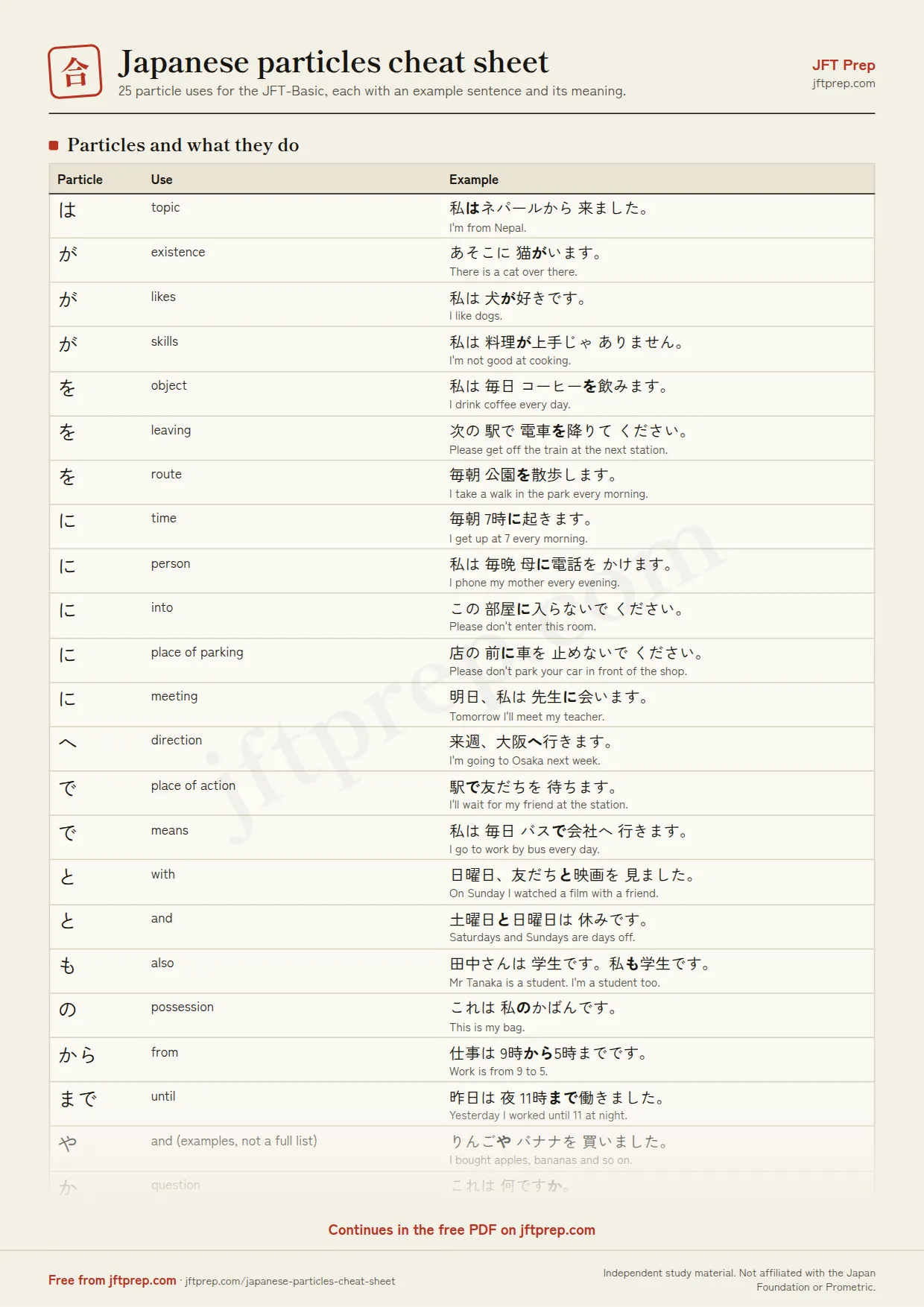
Particle questions are short, but they catch many learners, because the English translation does not help. Learn particles with the verb they go with.
Try it · Grammar
Choose the word that best fits in the blank.
Two co-workers are talking about their mornings.
- たかはし
- ロイさんは 毎朝 何時に うち 出ますか。
- ロイ
- 7時ごろです。会社まで 自転車で 20分ぐらいです。
Spot it: verbs of leaving and passing through take を: うちを 出る, でんしゃを おりる, はしを わたる, こうえんを さんぽする. Verbs of arriving take に: 会社に つく, でんしゃに のる.
Invitations and refusing politely
Japanese rarely says a direct "no". To turn down an invitation, people thank the speaker, start a "but", and let the sentence trail off with ちょっと….
Try it · Expression
Choose the best expression to fill in the blank.
A co-worker invites Ana to dinner after work.
- まつだ
- アナさん、こんばん みんなで ごはんを 食べに 行くんですが、いっしょに どうですか。
- アナ
- ありがとうございます。 、きょうは ちょっと よていが あって……。
- まつだ
- そうですか。じゃあ、また こんど。
Spot it: the reply じゃあ、また こんど ("another time, then") tells you Ana said no. The phrase before ちょっと… must be a soft refusal.
Keigo-lite: the polite phrases you need at work
You do not need to produce honorific grammar on the JFT-Basic. But you must recognise the polite set phrases used at work and in shops. Two of the most common:
Try it · Expression
Choose the best expression to fill in the blank.
Tran works in the office of a food factory. She answers the phone.
- チャン
- はい、さくら食品でございます。
- たなか
- 。みどり運送の 田中ですが、山本さんは いらっしゃいますか。
- チャン
- はい、少々 お待ちください。
Try it · Expression
Choose the best expression to fill in the blank.
Joseph's supervisor gives him a task.
- 上司
- ジョセフさん、この しりょうを 10まい コピーして もらえますか。
- ジョセフ
- 。すぐ やります。
- 上司
- ありがとう。たすかります。
Spot it: learn these as call-and-response pairs. A request from a boss gets かしこまりました or はい、わかりました. A business phone call opens with おせわに なって おります. Our workplace phrases by job lists the ones for your field.
Quick check: six fast ones
These are shorter than real test items, but they drill the same phrases and particles. Tap your answer.
Phrase and particle check
0 of 6 right
1.電車で 人に ぶつかって しまいました。何と 言いますか。
2.用事が おわって、会社に 帰って きました。何と 言いますか。
3.てんちょうの へやに 入ります。ドアを ノックして……
4.先生の 話が はやくて、わかりませんでした。何と 言いますか。
5.つぎの えきで でんしゃ( ) おります。
6.上司:「この はこ、ラベルが ちがいますよ。」あなた:「( )。すぐ なおします。」
The pattern table
Learn these as chunks, not rules. Each one has a clear job in a conversation, and the test asks you to match the job to the moment.
Asking, offering and permission
| Word | Reading | Meaning |
|---|---|---|
| 〜て ください | Please do …instructions, mild requests | |
| 〜て もらえませんか | Could you … for me?polite request; the favour comes to you | |
| 〜ても いいですか | May I …?asking permission | |
| 〜ては いけません | You must not …rules, warnings | |
| 〜なければ なりません | I/you must …duty | |
| 〜なくても いいです | You don't have to …the answer to 'must I?' with no | |
| 〜ませんか | Won't you …? / Shall we …?invitation, not a negative | |
| 〜ましょうか | Shall I …?offering help | |
| 〜た ほうが いいです | You had better …advice |
Joining two ideas
| Word | Reading | Meaning |
|---|---|---|
| 〜てから | after doing …order of actions | |
| 〜まえに | before doing …takes the dictionary form | |
| 〜ながら | while doing …two actions at the same time | |
| 〜ので | because …polite reason, common in apologies | |
| 〜たら | if / when …condition or 'after that happens' | |
| 〜ても | even if …contrast |
Expressions in pairs
| Word | Reading | Meaning |
|---|---|---|
| おさきに しつれいします | Excuse me for leaving firstreply: おつかれさまでした | |
| ただいま もどりました | I'm back (to the office)reply: おかえりなさい | |
| いってまいります | I'll go and come back (polite)reply: いってらっしゃい | |
| せっかくですが | It's kind of you, but …opens a polite refusal | |
| かしこまりました | Certainlyaccepting a task or an order | |
| もうしわけ ありません | I'm very sorrywork mistakes, causing trouble |
A 2-week drill plan for Conversation and Expression
This plan takes about 30 to 40 minutes a day. It fits next to your main coursebook study. The Japan Foundation's free Irodori course is built around the same daily-life situations, so its dialogues are good reading for this section.
| Day | Focus | What to do |
|---|---|---|
| 1 | Baseline | Take the free practice test. Note how many Conversation questions you missed. |
| 2 | Requests | Learn 〜て ください, 〜て もらえませんか, 〜て あげる. Write 5 requests you'd make at work. |
| 3 | Permission | 〜ても いいですか, 〜ては いけません, 〜なくても いいです. Make question-and-answer pairs. |
| 4 | Invitations | 〜ませんか, 〜ましょう, 〜ましょうか, plus refusing with せっかくですが and ちょっと…. |
| 5 | Particles 1 | に・で・を with movement verbs (出る・のる・おりる・つく). |
| 6 | Particles 2 | が・は・と・へ・から・まで. Do 20 grammar-quiz items. |
| 7 | Review | Redo every item you missed this week. Rest a little. |
| 8 | Joining forms | 〜てから, 〜まえに, 〜ながら, 〜とき. |
| 9 | Reasons and conditions | 〜ので, 〜から, 〜たら, 〜ても. |
| 10 | Work phrases | かしこまりました, しつれいします, おせわに なって おります, もうしわけ ありません. |
| 11 | Daily phrases | Greetings in pairs: home, shop, visit, meal, sick. Say them aloud. |
| 12 | Timed set | 12 Conversation questions in 6 minutes in section practice. |
| 13 | Full mock | One full timed mock test. Check your Conversation score against Day 1. |
| 14 | Fix | Review every miss from the mock. Add new phrases to your list. |
Two habits make this work. First, say every phrase out loud with its reply, as a pair. Second, keep a mistake notebook: write the dialogue, your wrong choice and the reason it was wrong. Review it every few days.
Free toolDrill the Conversation sectionSection practice gives you sets of Conversation and Expression questions with the key and an explanation for each choice.The short version
The Conversation and Expression section is about 12 short dialogues: grammar forms with four choices and set phrases with three. The reply after the gap is almost always your clue. Learn requests, permission, invitations, work phrases and particles as chunks, practise them as pairs, and aim to finish the section fast so you have time for listening and reading.
Free toolSee where you standThe free 12-question practice test covers all four sections and gives you an estimated band at the end.