Three months is the window many candidates get from an agent or employer: "pass the JFT-Basic by March and the job is yours." If you are starting from zero, that is a tight but workable deadline, as long as you know how many hours it really takes and you spend them on the right things. This plan is built on the official facts about the test and on the Japan Foundation's own estimate of how long its coursebook takes to study.
What "passing" actually means
The JFT-Basic does not have a pass or fail. It gives you a total score from 10 to 250 and a level. For the Specified Skilled Worker (i) visa you need the level the Japan Foundation calls A2.2 (A2), which starts at a total of 200. Some fields may ask for more, so check yours.
Three facts shape the whole plan:
- There is no minimum per section. The official FAQ says the level is judged across all four sections together. A strong reading score can make up for weaker listening.
- The test is short. About 50 questions in 60 minutes, one clock for everything. You need speed as well as knowledge.
- A miss costs time. Below 200, you must wait 45 days (counted from the day after your test) before you sit again. Booking too early can cost you six weeks of your three months.
- *10–144Below A1, shown as *
- A1145–174A1: Employment for Skill Development entry, language-school entry
- A2.1175–199A2.1: for job changes under Employment for Skill Development
- A2.2 (A2)200–250A2: Specified Skilled Worker (i)
How many hours does it take?
The Japan Foundation designed its free coursebook, Irodori: Japanese for Life in Japan, around the same "Can-do" goals as the JFT-Basic, and its FAQ says working towards the Can-dos from the Starter book to Elementary 2 can help you prepare for the test. The same FAQ estimates each lesson at about 150 to 180 minutes of activities, plus 1 to 2 hours of language-knowledge practice.
Do the arithmetic for one lesson: roughly 4 to 5 hours. Each book has 18 lessons.
- Irodori Starter (A1), 18 lessons
- ~80 h
- Irodori Elementary 1 (A2), 18 lessons
- ~80 h
- per week over 13 weeks
- 12–15 h
- full timed mock tests before booking
- 6+
These are our estimates from the official lesson time, not a promise. Learners who already know kana or another Asian language often move faster. People studying after a full working day often need longer. If you can only give 5 hours a week, plan for six months instead, and say so to your agent now rather than after a failed attempt.
The 13-week plan
Week 1: hiragana and katakana
Learn all 46 hiragana in the first four days and katakana in the last three. Drill them with the hiragana and katakana quiz for 20 minutes twice a day until you read every character without stopping. Everything after this depends on fast kana, so don't lean on romaji.
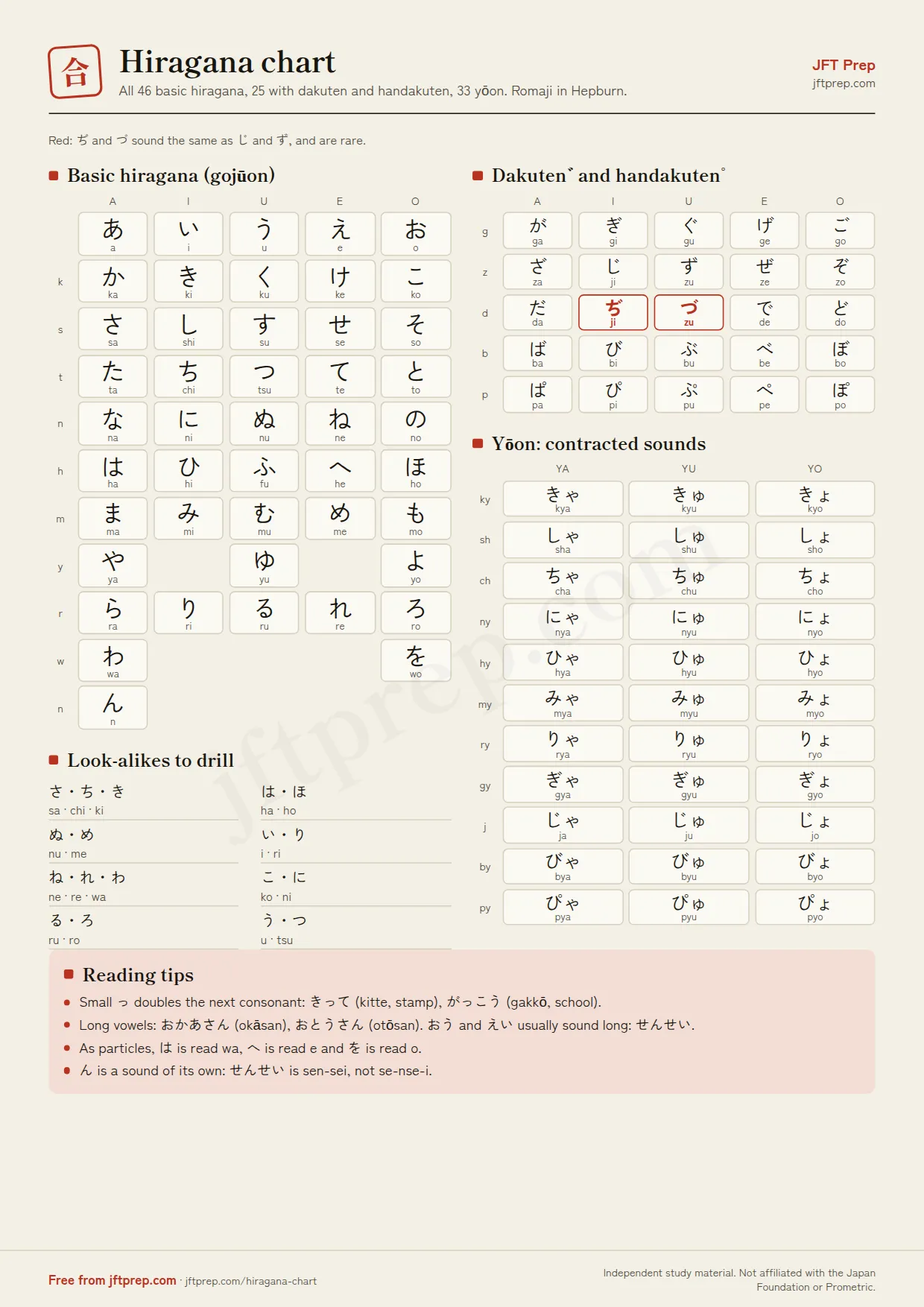 Free PDF cheat sheetHiragana chartAll 46 basic hiragana plus dakuten, handakuten and yōon, with romaji.Open the sheet PDF
Weeks 2–6: Irodori Starter
Three to four lessons a week. Do the listening activities with the MP3 files before you look at the script, and say every dialogue out loud. Copy the new kanji from each lesson by hand once, then review them on flashcards. At the end of week 6, take the free practice test to see where you stand.
Weeks 7–11: Irodori Elementary 1
Three to four lessons a week again. This is the A2 book, the level the 200 line stands for, and it adds much of the grammar and set expressions the Conversation and Expression section is built on. Keep 30 minutes a day for listening only: replay Irodori audio from earlier lessons and write down every number, time, price and place you hear.
Week 12: first full mock tests
Take two full timed mock tests under real conditions: one sitting, 60 minutes, headphones, no pausing, each clip played at most 2 times. Review every wrong answer and sort it into one of four piles: vocabulary, kanji, grammar, or "heard it but missed it".
Week 13: fix the weakest pile, then book
Spend the week on the pile with the most mistakes. Take a third mock at the end. If you clear the 200 line with room to spare on two mocks in a row, book the first good date on the Prometric schedule.
What to study each day
A typical 2-hour weekday in weeks 2 to 11 looks like this:
- 15 minutes: kana and kanji review (flashcards, then write five words from memory).
- 60 minutes: one Irodori activity block (listen first, read the script second, repeat aloud third).
- 20 minutes: vocabulary from the lesson word list, grouped by situation: shop, station, clinic, work.
- 25 minutes: listening only, no text. Old Irodori audio is fine. Train your ear on numbers, days and times, because those decide many listening answers.
At weekends, do one longer session: finish the week's last lesson and take a short section drill on whatever felt hardest.
Common mistakes in a 3-month plan
Studying a list instead of situations. The JFT-Basic asks what you would understand or say in a real place: a notice at the city office, an announcement at the station, a co-worker's question. Learn words with the scene they belong to. The vocabulary and kanji guide groups the core words this way.
Leaving listening to the end. Listening is one quarter of the questions, and it is the section people fear most. Your ear needs weeks, not days. Start in week 2.
Ignoring the clock. The test gives you one 60-minute clock for all four sections, and once you leave a section you cannot go back. Practise moving on from a hard question. The test format guide explains how the screens and timer work.
Booking on hope. If you book before your mock scores are steady above 200 and miss, the 45-day wait eats half of the next month and a half. One more week of practice is cheaper than a second test fee.
When and how to book
The JFT-Basic is held about every month in Japan and 14 countries in total, and bookings open in test periods on the Prometric site. You need a Prometric ID first, and booking closes at least 3 business days before the test (4 for a Saturday, Sunday or public holiday). Start watching the schedule for your country around week 8 so you know when seats open. The test dates and centres guide and the registration walkthrough cover each step.
On test day you see your total and level on screen at the end, and the official result notice appears in your Prometric account within 5 business days. It never expires, but print it: the data stays online for 5 years.
The short version
From zero, plan on roughly 160 hours: one week of kana, two Irodori books at three to four lessons a week, and two weeks of full mock tests. That is 12 to 15 hours a week for 13 weeks. Measure yourself with mocks, not feelings, and book only when you clear 200 twice in a row.