Start here: find your level
Every good plan starts with a measurement. Before you choose 4, 8 or 12 weeks:
- Take our free 12-question practice test (about 15 minutes, all four sections).
- If you get more than half right, take a full timed mock test for a score estimate out of 250.
Then pick your plan:
| Where you are now | Plan |
|---|---|
| You can read hiragana and katakana, and know greetings and a few basic sentences | 12 weeks |
| You have finished Irodori Starter (or a similar A1 course), or your mock is around A1 (145–174) | 8 weeks |
| You have studied Elementary 1 and 2 (or similar), or your mock is around 175–199 | 4 weeks |
If you cannot yet read kana, spend two weeks on that first. Our hiragana and katakana quiz (linked below) tells you which characters you still confuse. Every question on the test is written in Japanese script.
Your main book: Irodori
Irodori: Japanese for Life in Japan is the Japan Foundation's own coursebook, and its JFT-Basic pages recommend it. Its goals come from the JF Can-do for Life in Japan, the same set of daily-life tasks the test is based on. It is available online as PDF books with MP3 audio, with translations in 20 languages.
There are 4 levels of 18 lessons each:
| Level | CEFR | What the JF FAQ says it prepares you for |
|---|---|---|
| Starter | A1 | A1 (145–174) |
| Elementary 1 | A2 | A2.1 (175–199) on its own |
| Elementary 2 | A2 | A2.2 (200+) together with Elementary 1 |
| Pre-Intermediate | A2/B1 | Beyond the test; useful after you arrive |
So the 200 line for SSW means finishing Starter, Elementary 1 and Elementary 2. Pre-Intermediate is optional for the test.
The free IRODORI Japanese Online Course follows the same book with video lessons and practice for kanji and grammar, and its review quizzes use sections similar to the test. Use it if you learn better from video than from a PDF.
How to study one Irodori lesson
A lesson usually takes two to three study sessions. In this order:
- Listen first. Play the lesson's audio before reading the script. This trains the Listening section, where you have only 2 plays.
- Read the script and the word list. Note the new words in your own notebook or flashcards.
- Learn the kanji the lesson introduces, as words (駅 = えき, station), not as single characters.
- Shadow the dialogues. Repeat aloud just after the audio. There is no speaking test, but saying the phrases fixes them in memory.
- Do one short drill in the matching section (see the tools below).
The 12-week plan (from kana to 200)
For learners who can read kana and know very little else. Plan for about two hours a day, six days a week. This is our estimate, not an official figure. If you can only give one hour a day, stretch each phase to double the time.
| Weeks | Main study | Practice | Check |
|---|---|---|---|
| 1–4 | Irodori Starter, about 4–5 lessons a week | Daily: 15 new words and 3–5 kanji words. Kana quiz until it's 100% | End of week 4: practice test |
| 5–8 | Irodori Elementary 1, about 4–5 lessons a week | Daily: one 10-question section drill, alternating sections | End of week 6: first full mock test |
| 9–11 | Irodori Elementary 2, as many lessons as you can, focusing on the reading and listening tasks | Daily: listening drill + reading drill. Review all vocabulary lists | End of week 10: second full mock |
| 12 | Revision only: no new lessons | Two full mock tests under exam conditions, with full review | Book (or keep) your test only if both mocks are close to 200 |
Three lessons a day is not realistic for most people, so in weeks 9–11 prioritise Elementary 2's listening and reading tasks over finishing every page. They are closest to what the test asks.
Prefer paper? This printable version is a 12-week checklist made with our study planner, starting from kana. Tick off each task and stick it on your wall.
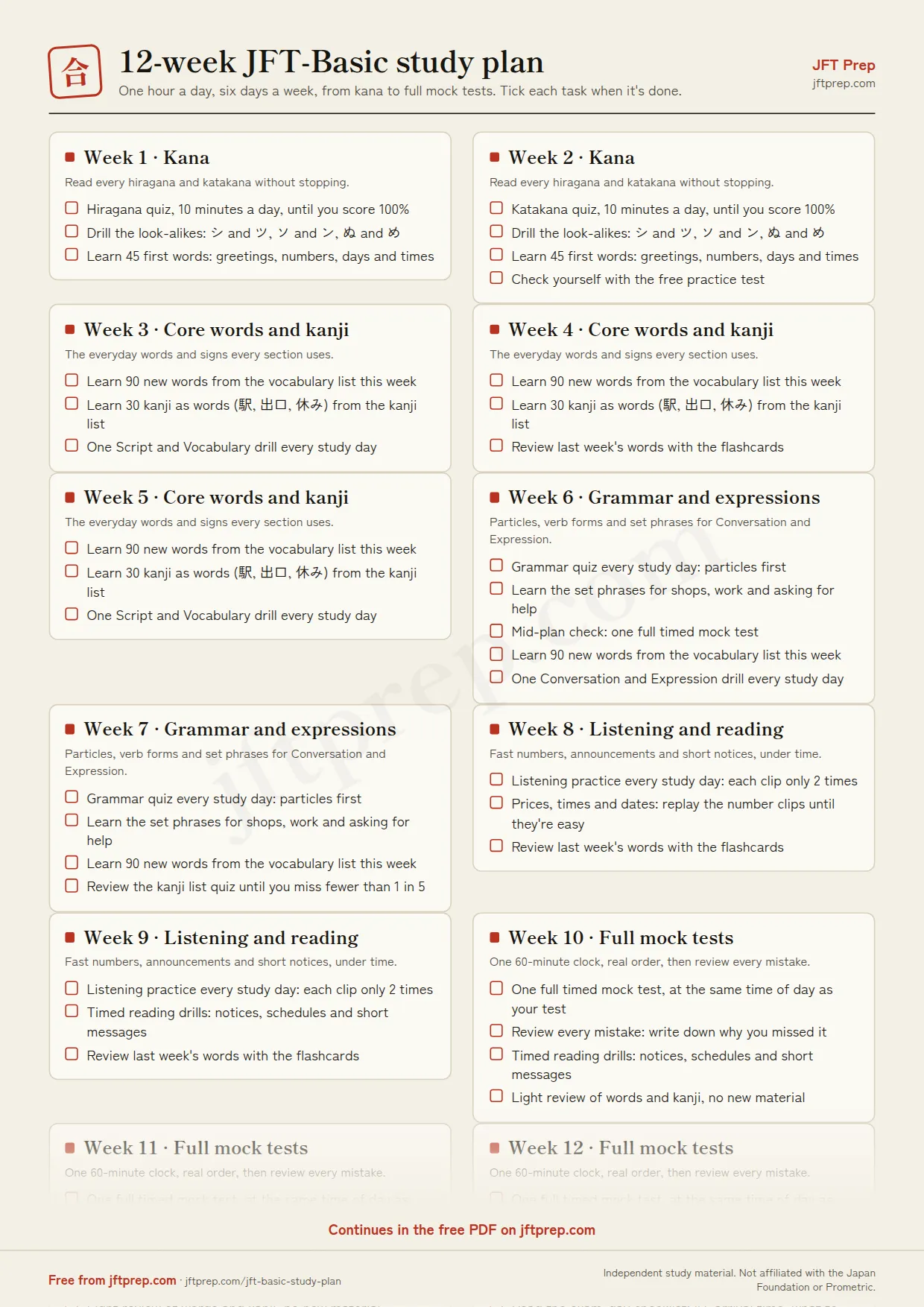
Free PDF cheat sheet
12-week JFT-Basic study plan (printable)
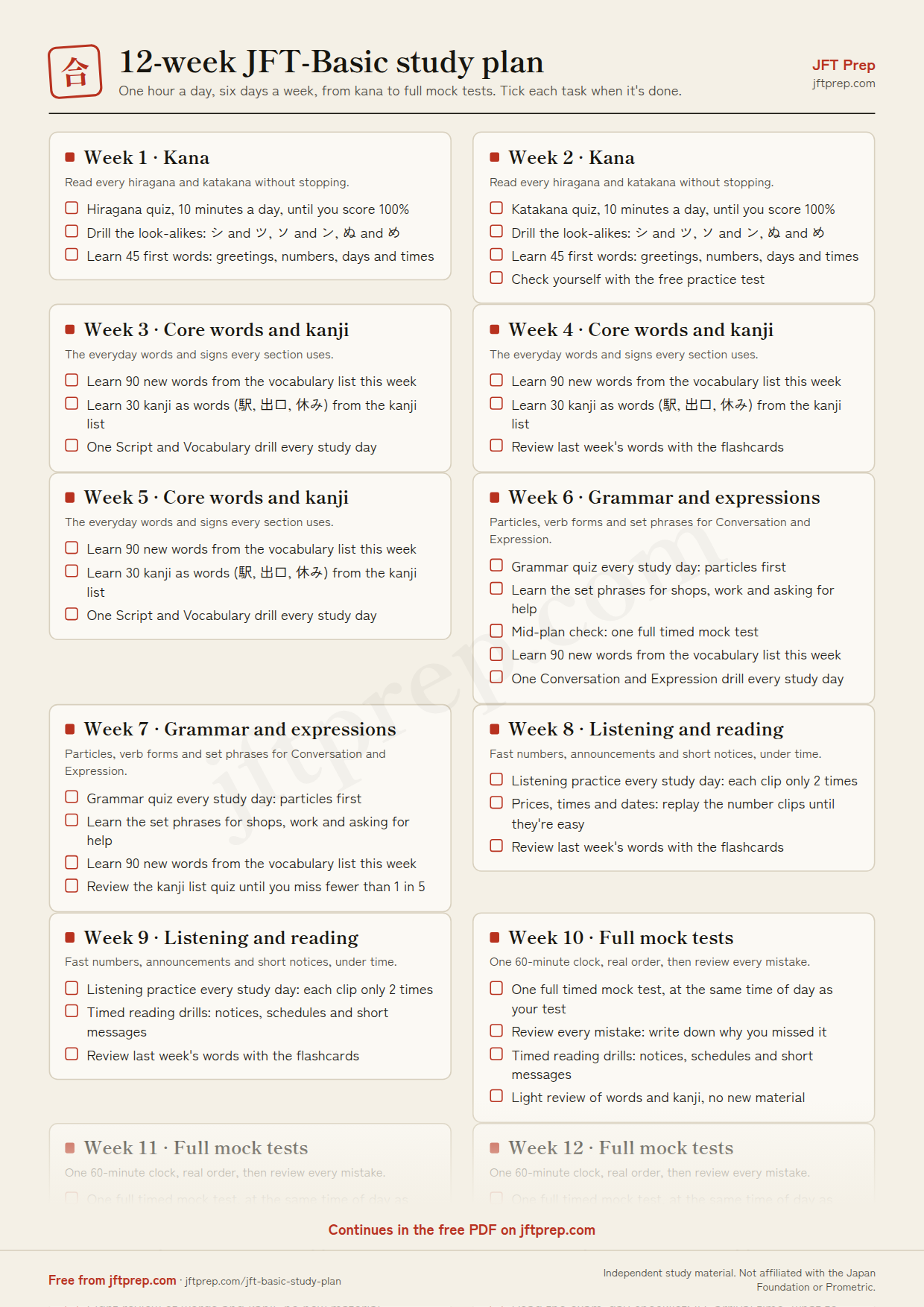
Free, no sign-up. Share it with your study group.
Updated Oct 31, 2026
The 8-week plan (from A1 to 200)
For learners who finished Starter, or score around 145–174 on a mock. About 1.5–2 hours a day.
| Weeks | Main study | Practice | Check |
|---|---|---|---|
| 1 | Quick Starter review: word lists and kanji only | Full mock test on day 1 to set a baseline | Note your weakest section |
| 2–4 | Irodori Elementary 1, about 6 lessons a week | Daily: one section drill in your weakest section, plus 10 new words | End of week 4: second mock |
| 5–7 | Irodori Elementary 2, about 6 lessons a week | Alternate daily: listening drill, reading drill | End of week 6: third mock |
| 8 | Revision and timing | Two full mocks; review every mistake | Ready if both mocks are at or above 200 |
The 4-week plan (from 175 to 200 and over)
For learners who have studied A2 material and score near the line. About 1–1.5 hours a day. No new coursebook: this plan fixes weak points and timing.
| Week | Focus | Daily tasks |
|---|---|---|
| 1 | Diagnose | Day 1: full mock. Rest of week: drills in your two weakest sections, review Elementary 1 word lists |
| 2 | Weakest section | Daily drills in that section. Re-read the Irodori lessons whose topics you missed. Mid-week mock |
| 3 | Reading speed and listening focus | Timed reading drills (aim for about 20 minutes for the whole Reading section). Listening drills using only the plays you will have on the day |
| 4 | Exam conditions | Two full mocks at the same time of day as your booked session. Light review only in the last two days |
How to use our practice tools
Each tool has a job in the plan:
- Study planner: enter your test date and starting level to get a week-by-week version of these plans.
- Practice test: 12 questions, about 15 minutes. Use it at the very start and whenever you want a quick check.
- Full mock test: the real order of sections, one 60-minute clock, no going back, listening clips that play twice. Use it as your milestone, never as daily practice.
- Section practice: short drills from one section with an explanation after each question. This is where daily improvement happens.
- Listening practice: short clips about prices, times and places, for your daily listening.
- Kana quiz: until you never hesitate over ソ and ン or シ and ツ.
- Vocabulary and kanji guide: the everyday words and signs to learn on top of Irodori.
Timing: the skill most plans forget
There is no time limit per section, only one 60-minute clock for about 50 questions. Reading is last, so slow candidates lose points there. Practise with a pacing plan, such as about 10 minutes each for the first two sections and about 20 minutes each for Listening and Reading, and adjust it after each mock.
When to book your test
Booking windows open about once every six weeks, and popular centres fill fast (see test dates). A good rule:
- Book for the end of your plan when your latest mock is close to 200 and rising.
- Move the booking (before the change deadline, 3 business days before the test) if two mocks in a row are clearly below 200.
- Never sit the real test as "practice". A score of 199 or lower means a 45-day wait and a new fee.
If you work full time
Many candidates study around a job. Then:
- Use the 12-week plan and stretch it to 16–20 weeks.
- Study vocabulary and kana in short breaks with flashcards, and keep long sessions for Irodori lessons and mocks.
- Keep one fixed weekly slot, such as Sunday morning, for a mock test or a long drill set.
Steady daily study is worth more than one long weekend session. Fifteen new words a day, six days a week, is about 1,000 words in twelve weeks.