Below are 19 JFT Basic exam questions with answers, spread over all four sections of the real test. Tap a choice to see if you are right, why, and why the other choices are wrong. Every question is original: written for this page in the official format, not copied from a past test or from the official samples.
- questions on this page
- 19
- sections, all covered
- 4
- questions on the real test
- ~50
- one clock for everything
- 60 min
The real test has about 50 questions in 60 minutes. That is a little over one minute per question, including listening. So as you work through this page, notice how long you take. Speed matters as much as knowledge.
Is there an official JFT Basic question bank or PDF?
No. The Japan Foundation, which makes the test, does not publish past papers. Its FAQ says there are currently no plans to do so. What it does publish is a small set of sample questions on the official JFT-Basic site, which show the screen and the question types. They are free, and you should try them.
So be careful with any "JFT Basic real questions PDF" you find in a chat group or on a video channel. It is not an official document. At best, it is someone's own practice questions. At worst, it is copied from memory, full of mistakes, and old. The real test also draws from a large bank, so memorising a list of answers does not work.
What works is the method you will see on this page: learn the 11 question types, learn the traps each type uses, and practise under time. Learners in Nepal often call these "model questions". The idea is the same.
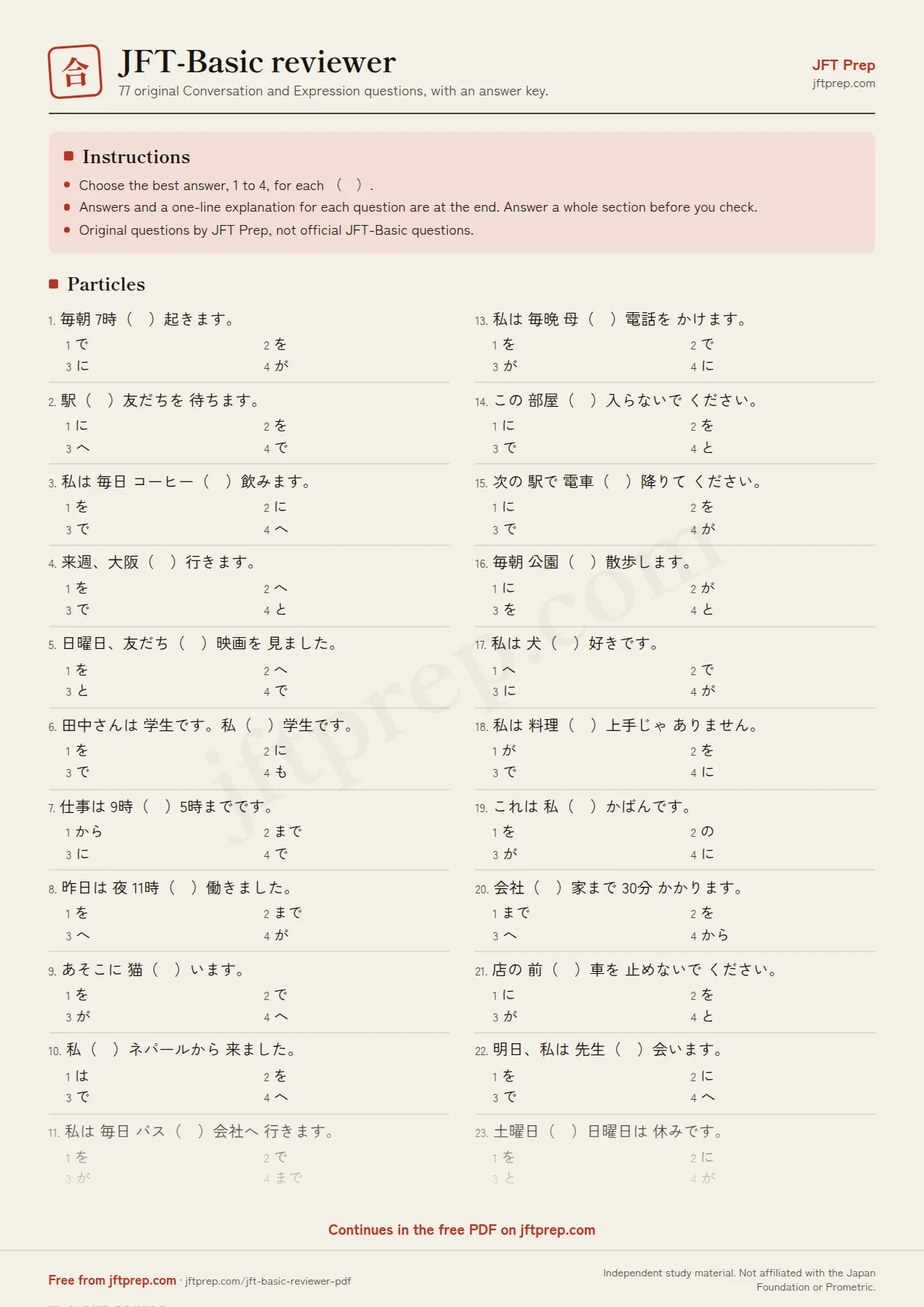
If you want a PDF to print, use ours: it is original practice material with an answer key, not leaked questions.
How to use this page
- Answer before you read the explanation. Guessing and then checking teaches you more than reading the key.
- No dictionary. The real test has none.
- Listening: read the English question and look at the pictures first. Then play the clip, no more than 2 times. The audio uses your browser's Japanese voice for now, so it may sound more robotic than the real test.
- Keep a list of your misses. Your mistakes show which section to study.
Section 1: Script and Vocabulary (5 questions)
This section tests words and kanji. In the official samples, each question has three choices. Aim for about 30 seconds each.
Try it · Word meaning
Look at the illustration and choose the correct word.
The trap: the wrong choice is often the opposite. Full and hungry use the same word, おなか, so read to the end of the phrase.
Try it · Word usage
Choose the word that best fits in the blank.
A co-worker is talking to you in the store room.
へやが くらいですね。でんきを ください。
The trap: an opposite pair (つける / けす) plus a verb for a different object. The clue is the first sentence, くらいですね.
Try it · Kanji reading
Choose the correct reading of the underlined word.
You are reading a message from a friend.
先月、えきの ちかくの アパートに ひっこしました。
The trap: one kanji, two readings. 月 is がつ in month names (三月) but げつ in 先月・今月・来月・毎月. Learn the word, not just the kanji.
Try it · Kanji reading
Choose the correct reading of the underlined word.
A man is giving you directions in the street.
この みちを まっすぐ 行くと、右に ゆうびんきょくが あります。
The trap: 右 and 左 look alike, so the test offers the reading of the other kanji. Notice the inside: 右 has 口, and 左 has 工.
Try it · Kanji meaning and usage
Choose the word that best fits in the blank.
Your supervisor is explaining your first day.
わからない ことが あったら、いつでも わたしに ください。
The trap: all three kanji have the "gate" part 門. Decide what the verb must mean first, then find the kanji with 耳 (ear) inside.
Section 2: Conversation and Expression (6 questions)
Grammar questions have four choices, often the same verb in four forms. Expression questions have three set phrases. The other speaker's reply is your best clue.
Try it · Grammar
Choose the word that best fits in the blank.
Two friends are talking on Friday evening.
- リサ
- あしたの 土曜日、いっしょに えいがを 。
- マヤ
- いいですね。何時に 会いますか。
The trap: 〜ませんか looks negative ("won't you?"), so learners avoid it. In Japanese it is the polite way to invite. The reply いいですね confirms it.
Try it · Grammar
Choose the word that best fits in the blank.
A visitor is talking to a guard at a temple.
- 客
- すみません、この たてものの 中で しゃしんを 。
- けいびいん
- すみません、中は だめなんです。外なら だいじょうぶですよ。
The trap: the answer does not contain "yes" or "no". You find it from だめなんです (not allowed), which only answers a permission question.
Try it · Grammar
Choose the word that best fits in the blank.
A dentist is talking to a patient.
- はいしゃ
- まいにち、ねる まえ はを みがいて くださいね。
- かんじゃ
- はい、わかりました。
The trap: まえ can also mean "in front of" a place (えきの まえで). Here it follows a verb (ねる), so it is about time, and time takes に.
Try it · Grammar
Choose the word that best fits in the blank.
Two co-workers are talking at lunch time.
- やまだ
- ジョンさん、きょう、かえりに スーパーに よりますか。
- ジョン
- はい。しごとが 行きます。たまごを 買いたいので。
The trap: から appears in two choices with different meanings. After a て-form it means "after"; after a plain form it means "because".
Try it · Expression
Choose the best expression to fill in the blank.
Grace is calling her workplace early in the morning.
- グレース
- もしもし、グレースです。 、ねつが あるので、きょうは 休んでも いいですか。
- てんちょう
- わかりました。ゆっくり 休んで ください。おだいじに。
The trap: all three are polite, so politeness does not decide it. Ask what the speaker is doing: here, asking a favour that troubles someone.
Try it · Expression
Choose the best expression to fill in the blank.
A co-worker gives Arjun some sweets from her trip.
- きむら
- アルジュンさん、これ、りょこうの おみやげです。どうぞ。
- アルジュン
- わあ、 。
The trap: いただきます and ごちそうさまでした are a before/after pair. Arjun has just received the sweets, so it is "before".
Section 3: Listening Comprehension (4 questions)
On the real test, the question is written in English and the choices are pictures. Here the pictures are described in words until the images are ready. Read the question before you press play.
Try it · Conversation
Listen to the conversation and choose the correct picture.
A supervisor and a worker are talking about tomorrow's job. What time should the worker come tomorrow?
Play as often as you like
The trap: every clock in the pictures is mentioned. The answer needs a small sum (7:30 minus 15 minutes). Listen for いいえ: it marks the correction.
Try it · At shops and public places
Listen to the conversation and choose the correct picture.
A woman is sending a parcel at the post office. How does she send it?
Play as often as you like
The trap: she never says ふね in her answer. She says やすい ほう (the cheaper one), so you must remember which option was cheaper.
Try it · Announcements and instructions
Listen to the announcement and answer the two questions.
You live in a company dormitory. You hear this announcement on the speaker in the hall.
Play as often as you like
The trap: the park is mentioned, but only to say no. Listen for 〜では ありません: announcements often name the wrong place on purpose. ひなんくんれん means an evacuation drill, which is common at Japanese workplaces and dormitories.
Section 4: Reading Comprehension (4 questions)
The instructions are in English, but the questions and choices are in Japanese. Read the question first, then look for the answer in the text.
Try it · Comprehending content
Read the message and answer the two questions.
You work part-time at a restaurant. The manager sent this message to all staff.
来週の 店の 時間に ついて
みなさん、おつかれさまです。店長の 山下です。 来週は 店の 工事が あるので、時間が 少し かわります。月曜日から 水曜日までは、店を 午後2時に 開けます。いつもより 3時間 おそいです。木曜日からは いつもと 同じです。 それから、工事の 人が うらの 入口を 使うので、みなさんは 使わないで ください。店の 前の 入口から 入って ください。 新しい 時間表は、あした メールで おくります。
The trap: the wrong choices reuse words from the text (うらの 入口, 工事の 人) in the wrong way. The right choice says what the text tells you to do.
Try it · Information search
Look at the information and answer the two questions.
Raj's company is planning a day out. He is looking at the zoo's website.
みなと動物園 ごあんない
開園時間 9:30〜17:00(入園は 16:30まで) 休園日 毎週 月曜日(月曜日が 祝日の ときは、つぎの 日) ※10人以上の グループは、一人 100円 安く なります。
| 入園料 | |
|---|---|
| 大人(高校生以上) | 800円 |
| 中学生 | 300円 |
| 小学生以下 | 無料 |
The trap: the small print. Most information-search questions need the table and a note together. Read every ※ line and every bracket before you answer.
How did you do?
Count your correct answers. This is only a rough guide, because the real test uses a scaled score, not a count:
- 16 or more: you know the formats well. Now test your speed with a full timed paper.
- 11 to 15: you are close. Find the section where you missed most and drill it.
- 10 or fewer: go back to the coursebook for a few weeks. The Japan Foundation points learners to its free Irodori course, and our study plan shows the order.
The traps above repeat across the whole test: opposites, one-sound differences, look-alike kanji, changed plans, and notes in documents. Once you can name the trap, the question gets much easier. Our sample questions guide explains each of the 11 question types in more detail.
How to save these questions as a PDF
You can keep this page as a PDF to study offline or print.
Answer the questions first
The answer and explanation only open after you choose. Answer all 19, so your PDF includes every key and every "why".
Open the print menu
On a computer, press Ctrl + P (Cmd + P on a Mac). On an Android phone in Chrome, tap the ⋮ menu, then Share, then Print. On an iPhone, tap Share, then Print.
Choose 'Save as PDF'
Set the printer to "Save as PDF" and save. The file is yours to keep.
What to do next
Nineteen questions show you the format. They don't show you whether you can keep your focus for 60 minutes and about 50 questions, with no going back to an earlier section. That is the real challenge.
- Take the free practice test (12 questions, timed, with an estimated band).
- Then sit a full mock test under real conditions: one clock, four sections, two plays per clip.
- Drill your weakest section in section practice.