To pass the JFT-Basic in the Philippines, you need a total of 200 or more out of 250. That is what Philippine job ads call a "JFT passer". Your English is a real advantage. Kanji and listening are where most Filipino candidates lose points, so a good reviewer drills those two first.
- the score a "JFT passer" has
- 200+
- of Filipino test-takers reached it (Aug–Sep 2026)
- 35.5%
- one clock for all four sections
- 60 min
- this reviewer and the practice test
- Free
This page is a free reviewer: words to know, seven test-style questions with answers, and a 7-day plan you can tick off. For the fee, test centres and ID rules, read the JFT-Basic Philippines guide. We stay on strategy here.
What does "JFT passer" mean?
"JFT passer" is a Philippine job-ad term, not an official one. The JFT-Basic doesn't say "pass" or "fail". It gives you a score from 10 to 250 and a level. Since August 2026 the Japan Foundation reports three levels: A1, A2.1 and A2.2 (A2).
When an agency asks for a "JFT passer", it means A2.2: a score of 200 or more. That is the Japanese level the Specified Skilled Worker (i) visa needs. A score of 175–199 (A2.1) is close, but it doesn't meet the SSW line.
Three things to know about the result:
- Only the total counts. There is no minimum score per section.
- You can't retake once you reach 200. You don't need to.
- Below 200, you wait 45 days before you can sit the test again. The retake calculator shows the exact date.
The JLPT N4 is also accepted for SSW instead of the JFT-Basic. Our JFT-Basic vs JLPT N4 guide compares them.
How do Filipino candidates do on the JFT-Basic?
The Japan Foundation publishes a report after each test period. Here are the Philippine figures for 2026, next to the result across all test sites:
| Test period (2026) | Test-takers in the Philippines | Philippines: reached A2 (200+) | All test sites |
|---|---|---|---|
| April–May | 1,342 | 42.2% | 54.4% |
| June–July | 1,524 | 46.7% | 51.3% |
| August–September | 2,082 | 35.5% | 41.3% |
In every period, the Philippines was below the all-sites figure. In August–September, another 20.7% of Filipino test-takers scored 175–199. That group was close: a few weeks of focused review could have moved many of them over the line.
The report doesn't show scores by section, so official data can't say which section costs Filipinos the most. But the test's design points to two likely weak spots for English speakers. We cover them next.
Free toolFind your weak section in 15 minutes12 original questions across all four sections, with a free band estimate. No sign-up.Your strengths and weak spots as a Filipino candidate
Strength 1: English instructions. On screen, every instruction and every listening question is in English. You read them fast, so all your attention goes to the Japanese. (Filipino and Tagalog are not on the language menu, but you won't need them.)
Strength 2: Katakana words. Many Japanese words come from English: コンビニ (convenience store), エレベーター (elevator), シフト (shift). Once you read katakana, these feel familiar. Be careful, though: マンション means an apartment building, not a mansion.
Weak spot 1: Kanji. Romaji helps you at the start, then becomes a trap. The test uses no romaji and no furigana (small reading guides over kanji). If you learned from romaji videos, switch to kana now. Then learn the kanji you see on signs, timetables and work notices.
Weak spot 2: Listening. Each clip plays at most 2 times, at natural speed. Filipino learners often understand a word when they read it but miss it when it is spoken. Numbers, times and prices decide many answers. Train your ear every day, not just in the last week.
The reviewer, part 1: words to know
Learn these with their readings. Cover the kana column and test yourself. For the full lists, use the kanji list and the vocabulary list.
Signs, places and time
| Word | Reading | Meaning |
|---|---|---|
| 入口 | いりぐち | entrance |
| 出口 | でぐち | exit |
| 受付 | うけつけ | reception desk |
| 午前 | ごぜん | a.m., morning |
| 午後 | ごご | p.m., afternoon |
| 休み | やすみ | day off, closed |
| 禁煙 | きんえん | no smoking |
| 危ない | あぶない | dangerous |
Work and care
| Word | Reading | Meaning |
|---|---|---|
| 仕事 | しごと | work, job |
| 会社 | かいしゃ | company |
| 薬 | くすり | medicine |
| 病院 | びょういん | hospital, clinic |
| 熱 | ねつ | fever |
| 手伝います | てつだいます | to help |
| お先に失礼します | おさきにしつれいします | said when you leave work before others |
| お疲れさまでした | おつかれさまでした | thanks for your work (reply) |
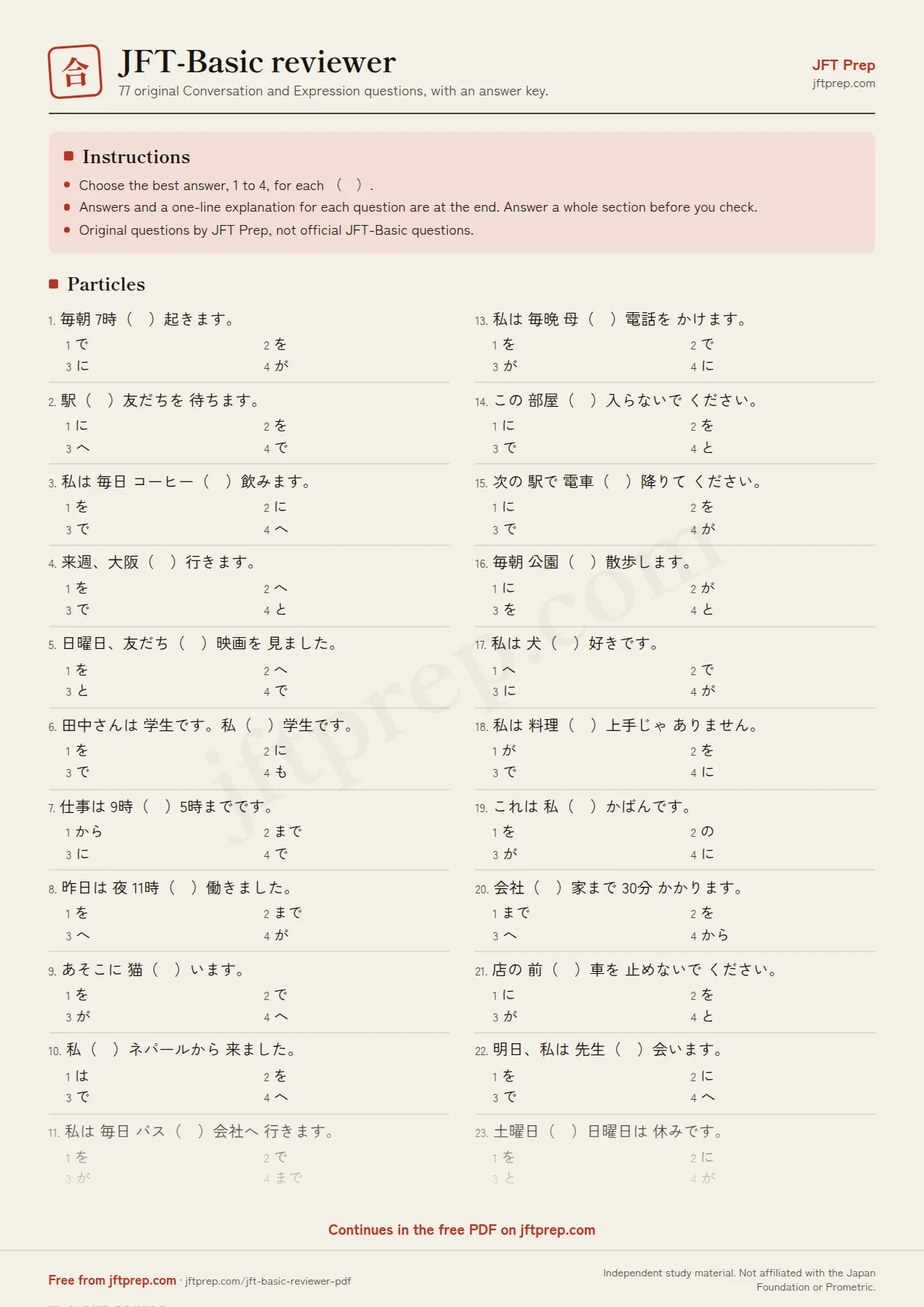
The reviewer, part 2: seven test-style questions
These are original questions in the real format. Answer before you read the explanation. Grammar has four choices; every other type has three.
Script and Vocabulary
Try it · Word meaning
Look at the illustration and choose the correct word.
Try it · Kanji reading
Choose the correct reading of the underlined word.
You see a notice on the door of a pharmacy.
日曜日は 休み です。
Try it · Kanji meaning and usage
Choose the word that best fits in the blank.
Maria is reading a sign at a factory.
ここは ですから、たばこを すわないで ください。
Conversation and Expression
Try it · Grammar
Choose the word that best fits in the blank.
Joy, a care worker, is talking to her senior co-worker Yamada.
- やまだ
- ジョイさん、たなかさんの へやの そうじは おわりましたか。
- ジョイ
- いいえ、まだです。たなかさんが ごはんを 、そうじします。
- やまだ
- わかりました。おねがいします。
Try it · Expression
Choose the best expression to fill in the blank.
Mark arrives at work ten minutes late. His manager is waiting.
- マーク
- 。電車が おくれました。
- てんちょう
- そうですか。じゃあ、すぐ じゅんびして ください。
Listening
Try it · At shops and public places
Listen to the conversation and choose the correct picture.
A woman is asking at a hospital reception. When should she come back?
Play as often as you like
Listening tip. All three times are spoken. The answer is the one the clerk asks for. Listen for 〜までに ("by") and 〜てください ("please do").
Reading
Try it · Information search
Look at the notice and answer the question.
You live in a company dormitory. This notice is on the wall.
ごみの 日
| ごみ | 日 | 時間 |
|---|---|---|
| もえる ごみ | 月・木 | 午前8時まで |
| びん・かん | 水 | 午前8時まで |
| ペットボトル | 金 | 午前9時まで |
The 7-day JFT Basic reviewer plan
Use this in the last week before your test, or as your first week back to studying. Each day is about 90 minutes. Tick each day off; your ticks stay on this device.
7-day reviewer plan
0 of 7 done
If your mock score on day 6 is well below 200, don't book yet. One more month of study costs less than a second test fee and a 45-day wait.
Common reviewer mistakes
Memorising answer keys. If a "reviewer" claims to hold real test questions, skip it. Memorised answers don't build the skill the test checks. Learn the skill, not the answer.
Studying only from romaji. It feels fast at first, but on test day there is no romaji. Read in kana from week one.
Skipping the clock. The test has about 50 questions in 60 minutes, with one clock for all four sections. Practise moving on from a hard question.
Leaving listening for last. Your ear needs weeks. Five minutes of audio a day is better than two hours the night before.
After you pass: the DMW and SSW basics
The JFT-Basic is only the language part of SSW. You also need the skills test for your job field. Caregivers take the Nursing Care skills test and a separate care Japanese test. See the SSW visa guide.
If a Japanese employer hires you from the Philippines, Philippine rules apply too. The Immigration Services Agency of Japan summarises them:
- The employer must recruit through a DMW-licensed agency. You can check any agency on the DMW licence search.
- The employer's papers are reviewed by the Migrant Workers Office (MWO) in Tokyo or Osaka.
- Before you fly, you attend a pre-departure seminar, get a medical check, and receive an Overseas Employment Certificate (OEC).
The Philippines guide explains each step in detail.
When is the next JFT-Basic schedule in the Philippines?
Prometric lists the next test period as 1 December 2026 to 15 January 2027. Booking opens on 25 November 2026 at about 10:00 AM Japan time, which is about 9:00 AM in Manila. Bookings close at least 3 business days before your test date. Always check the Prometric schedule before you plan, and see the registration guide for the booking steps.
Your official result appears in your Prometric account within 5 business days. Print it: agencies will ask for it.
Start your reviewer today
Take the free practice test first. It shows your estimated band and your weakest section in about 15 minutes. Then follow the 7-day plan above. When your mock scores sit above 200 twice in a row, you are ready to book.
Free toolTake the free practice testSee your estimated JFT-Basic band and your weakest section. 12 questions, no sign-up.