Free reviewer · Questions and answers
JFT Basic reviewer PDF with answers (free)
This free JFT-Basic reviewer PDF has 77 original practice questions in the style of the Conversation and Expression grammar items: particles, verb forms, adjectives, counters and polite expressions. Each question has four options, like the real grammar questions, and the answer key at the end explains every answer. It's our own material, not official questions, and it has no listening, so pair it with a timed mock test.
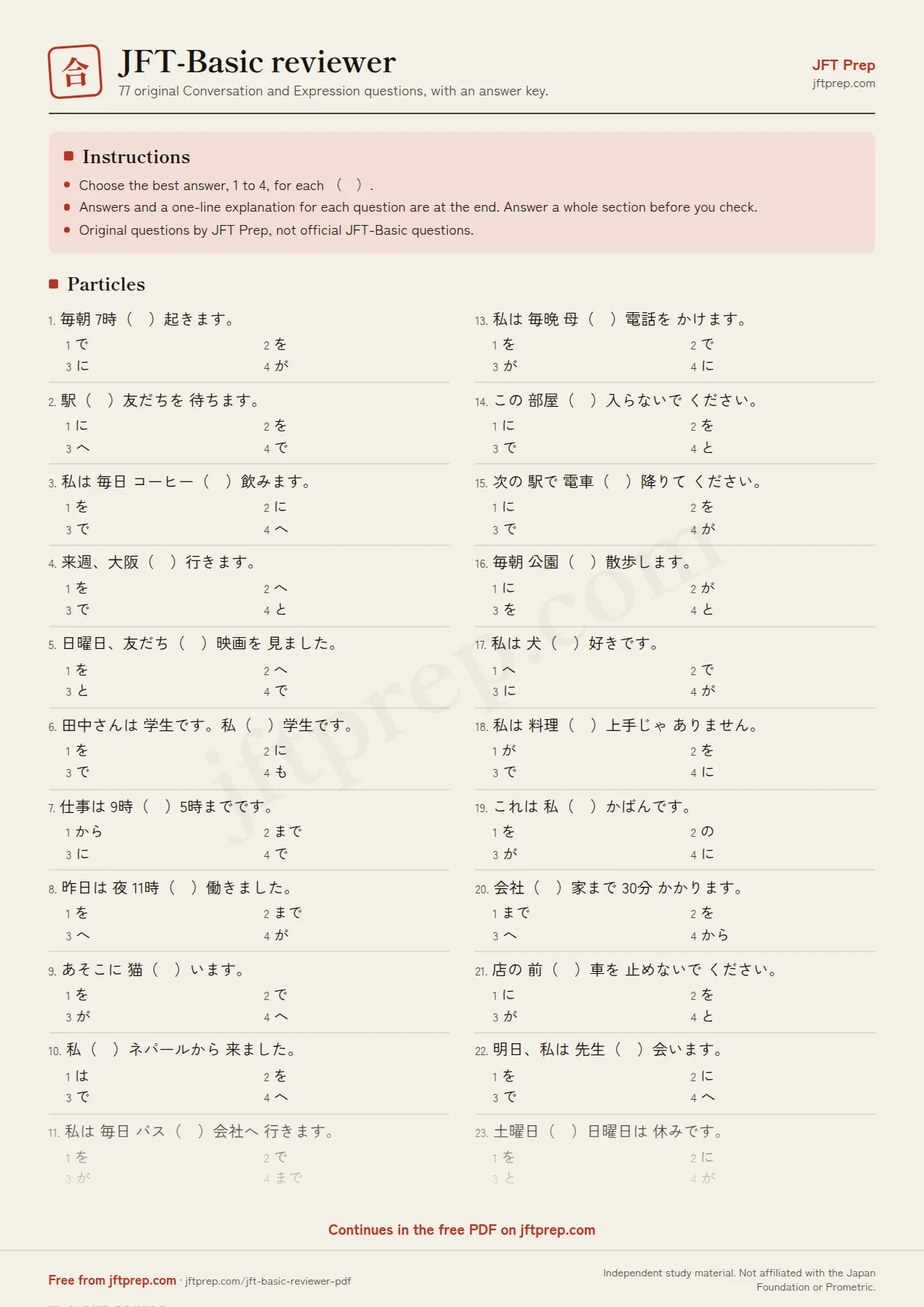
Free PDF cheat sheet
JFT-Basic reviewer: 77 questions with answers
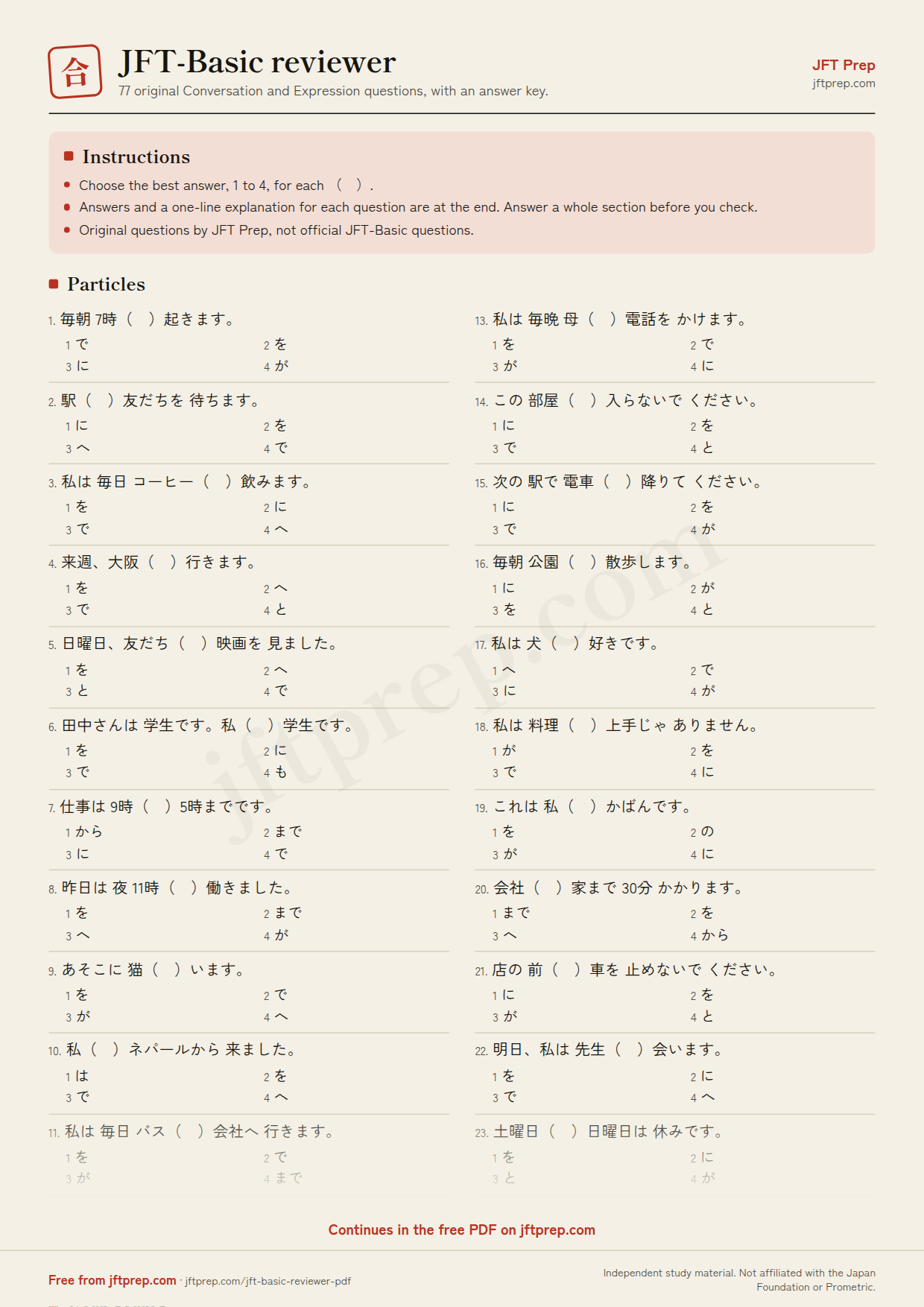
Free, no sign-up. Share it with your study group.
Updated Oct 31, 2026
The sheet
JFT-Basic reviewer
The same content as the PDF. Use the switches to hide parts and test yourself; tap a hidden cell to reveal it.
77 original Conversation and Expression questions, with an answer key.
Instructions
- Choose the best answer, 1 to 4, for each ( ).
- Answers and a one-line explanation for each question are at the end. Answer a whole section before you check.
- Original questions by JFT Prep, not official JFT-Basic questions.
Particles
1.毎朝 7時( )起きます。
- 1で
- 2を
- 3に
- 4が
Answer: 3 · に marks a specific point in time, such as a clock time. I get up at 7 every morning.
2.駅( )友だちを 待ちます。
- 1に
- 2を
- 3へ
- 4で
Answer: 4 · で marks the place where an action (waiting) happens. I'll wait for my friend at the station.
3.私は 毎日 コーヒー( )飲みます。
- 1を
- 2に
- 3で
- 4へ
Answer: 1 · を marks the direct object of the verb: what you drink. I drink coffee every day.
4.来週、大阪( )行きます。
- 1を
- 2へ
- 3で
- 4と
Answer: 2 · へ marks the direction or destination of movement verbs like 行きます. I'm going to Osaka next week.
5.日曜日、友だち( )映画を 見ました。
- 1を
- 2へ
- 3と
- 4で
Answer: 3 · と means 'with' a person who does the action together with you. On Sunday I watched a film with a friend.
6.田中さんは 学生です。私( )学生です。
- 1を
- 2に
- 3で
- 4も
Answer: 4 · も replaces は and means 'also / too'. Mr Tanaka is a student. I'm a student too.
7.仕事は 9時( )5時までです。
- 1から
- 2まで
- 3に
- 4で
Answer: 1 · から 〜 まで means 'from … to …'; から marks the start. Work is from 9 to 5.
8.昨日は 夜 11時( )働きました。
- 1を
- 2まで
- 3へ
- 4が
Answer: 2 · まで marks the end point in time: 'until 11 at night'. Yesterday I worked until 11 at night.
9.あそこに 猫( )います。
- 1を
- 2で
- 3が
- 4へ
Answer: 3 · With います / あります, が marks the person, animal or thing that exists. There is a cat over there.
10.私( )ネパールから 来ました。
- 1は
- 2を
- 3で
- 4へ
Answer: 1 · は marks the topic of the sentence: 'As for me, …'. I'm from Nepal.
11.私は 毎日 バス( )会社へ 行きます。
- 1を
- 2で
- 3が
- 4まで
Answer: 2 · で marks the means of transport: 'by bus'. I go to work by bus every day.
12.日本語( )手紙を 書きました。
- 1を
- 2に
- 3で
- 4が
Answer: 3 · で also marks the language or tool you use: 'in Japanese'. I wrote a letter in Japanese.
13.私は 毎晩 母( )電話を かけます。
- 1を
- 2で
- 3が
- 4に
Answer: 4 · に marks the person who receives the action: you call *to* your mother. I phone my mother every evening.
14.この 部屋( )入らないで ください。
- 1に
- 2を
- 3で
- 4と
Answer: 1 · 入ります takes に for the place you go into. Please don't enter this room.
15.次の 駅で 電車( )降りて ください。
- 1に
- 2を
- 3で
- 4が
Answer: 2 · 降ります takes を for the vehicle or place you get off / leave. Please get off the train at the next station.
16.毎朝 公園( )散歩します。
- 1に
- 2が
- 3を
- 4と
Answer: 3 · を can mark the area you move through, as with 散歩します. I take a walk in the park every morning.
17.私は 犬( )好きです。
- 1へ
- 2で
- 3に
- 4が
Answer: 4 · 好きです marks what you like with が. I like dogs.
18.私は 料理( )上手じゃ ありません。
- 1が
- 2を
- 3で
- 4に
Answer: 1 · 上手です / 下手です mark the skill with が. I'm not good at cooking.
19.これは 私( )かばんです。
- 1を
- 2の
- 3が
- 4に
Answer: 2 · の links two nouns: 'my bag'. This is my bag.
20.会社( )家まで 30分 かかります。
- 1まで
- 2を
- 3へ
- 4から
Answer: 4 · から marks the starting point of a distance: 'from the office'. It takes 30 minutes from the office to my home.
21.店の 前( )車を 止めないで ください。
- 1に
- 2を
- 3が
- 4と
Answer: 1 · 止めます takes に for the place where something is left or parked. Please don't park your car in front of the shop.
22.明日、私は 先生( )会います。
- 1を
- 2に
- 3で
- 4へ
Answer: 2 · 会います takes に for the person you meet. Tomorrow I'll meet my teacher.
23.土曜日( )日曜日は 休みです。
- 1を
- 2に
- 3と
- 4が
Answer: 3 · と joins nouns in a complete list: 'Saturday and Sunday'. Saturdays and Sundays are days off.
Verb forms
24.すみません、ちょっと( )。
- 1待って ください
- 2待ちて ください
- 3待つ ください
- 4待って たい
Answer: 1 · Requests use the te-form + ください; the te-form of 待つ is 待って. Excuse me, please wait a moment.
25.危ないですから、この 機械に( ) ください。
- 1さわらなくて
- 2さわらないで
- 3さわって
- 4さわる
Answer: 2 · 〜ないでください asks someone not to do something; 危ない tells you it's a 'don't'. It's dangerous, so please don't touch this machine.
26.私は 日本で( )です。
- 1働くたい
- 2働いてたい
- 3働きたい
- 4働きます
Answer: 3 · 〜たい (want to) attaches to the masu-stem: 働き + たい. I want to work in Japan.
27.田中さんは 今 電話を( )。
- 1するています
- 2したいます
- 3しっています
- 4しています
Answer: 4 · Te-form + います describes an action in progress right now (今). Mr Tanaka is on the phone now.
28.私は 富士山に 登った( )。
- 1ことが あります
- 2ことが います
- 3ことを あります
- 4ことで います
Answer: 1 · Ta-form + ことがあります means 'I have (once) done …'. I have climbed Mount Fuji.
29.疲れましたね。少し( )。
- 1休むましょう
- 2休みましょう
- 3休まましょう
- 4休みたいましょう
Answer: 2 · 〜ましょう (let's) attaches to the masu-stem: 休み + ましょう. We're tired, aren't we? Let's take a short break.
30.朝ごはんを( )、会社へ 行きます。
- 1食べで
- 2食べるて
- 3食べて
- 4食べた
Answer: 3 · The te-form joins actions in order: 'eat, and then go'. I eat breakfast and then go to work.
31.暑いですね。窓を( )も いいですか。
- 1開けで
- 2開けた
- 3開ける
- 4開けて
Answer: 4 · Te-form + もいいですか asks for permission: 'May I open …?'. It's hot. May I open the window?
32.私は 今 東京に( )。
- 1住んでいます
- 2住みています
- 3住むています
- 4住っています
Answer: 1 · 住む → 住んで; 住んでいます describes where you live now. I live in Tokyo now.
33.去年から 毎日 日本語を( )。
- 1勉強しいます
- 2勉強するています
- 3勉強しています
- 4勉強しってます
Answer: 3 · する → して; して + います describes an ongoing habit. I've been studying Japanese every day since last year.
34.ここに 名前を( ) ください。
- 1書きて
- 2書って
- 3書いで
- 4書いて
Answer: 4 · Verbs ending in く change to いて: 書く → 書いて. Please write your name here.
35.雨ですから、傘を( )行って ください。
- 1持って
- 2持ちて
- 3持たて
- 4持つて
Answer: 1 · 持つ → 持って; 持って行きます means take (something) with you. It's raining, so please take an umbrella.
36.私は すしを 食べた( )が ありません。
- 1ところ
- 2こと
- 3ため
- 4まで
Answer: 2 · Ta-form + ことがありません means 'I have never done …'. I have never eaten sushi.
37.図書館では 大きい 声で( ) ください。
- 1話さなくて
- 2話す
- 3話さないで
- 4話した
Answer: 3 · Libraries are quiet places, so this is a 'please don't': 話さないでください. Please don't talk loudly in the library.
38.一緒に 昼ごはんを( )か。
- 1食べなくて
- 2食べて
- 3食べないで
- 4食べません
Answer: 4 · 〜ませんか is a polite invitation: 'Won't you … with me?'. Would you like to have lunch together?
39.A:今、何を していますか。 B:母に 手紙を( )。
- 1書いています
- 2書いてください
- 3書きましょう
- 4書かないで
Answer: 1 · The question asks what you are doing now, so the answer uses 〜ています. A: What are you doing now? B: I'm writing a letter to my mother.
40.明日は 休みですから、映画を( )に 行きます。
- 1見て
- 2見
- 3見る
- 4見た
Answer: 2 · Masu-stem + に行きます means 'go to do …': 見に行きます. Tomorrow is my day off, so I'm going to see a film.
41.ドアを( )から、部屋を 出ます。
- 1閉めで
- 2閉めって
- 3閉めて
- 4閉まて
Answer: 3 · Te-form + から means 'after doing …': 閉めてから. I'll close the door and then leave the room.
42.すみません、もう 一度( ) ください。
- 1言いて
- 2言んで
- 3言て
- 4言って
Answer: 4 · Verbs ending in う change to って: 言う → 言って. Sorry, could you say that once more, please?
Adjectives
43.この ラーメンは とても( )です。
- 1おいしいな
- 2おいしくて
- 3おいしいだ
- 4おいしい
Answer: 4 · い-adjectives go straight before です, with no な or だ. This ramen is very tasty.
44.昨日は とても( )です。
- 1暑かった
- 2暑いだった
- 3暑かったでした
- 4暑くて
Answer: 1 · Past of an い-adjective: drop い, add かった, then です. It was very hot yesterday.
45.この 部屋は( )、明るいです。
- 1広いで
- 2広くて
- 3広いくて
- 4広くで
Answer: 2 · To join い-adjectives, change い to くて: 広い → 広くて. This room is big and bright.
46.私の 町は( )町です。
- 1静かの
- 2静か
- 3静かな
- 4静かに
Answer: 3 · な-adjectives take な before a noun: 静かな町. My town is a quiet town.
47.この 仕事は あまり( )。
- 1難しいです
- 2難しいじゃないです
- 3難しかったです
- 4難しくないです
Answer: 4 · あまり needs a negative; for い-adjectives the negative is 〜くないです. This job is not very difficult.
48.田中さんは( )、親切です。
- 1きれいで
- 2きれいくて
- 3きれいだて
- 4きれいな
Answer: 1 · きれい is a な-adjective (despite the い), so it joins with で. Ms Tanaka is pretty and kind.
49.今日は 天気が( )ないです。
- 1いく
- 2よく
- 3よい
- 4いい
Answer: 2 · いい is irregular: its negative is よくないです. The weather isn't good today.
50.使った あとで、部屋を( )して ください。
- 1きれいな
- 2きれいで
- 3きれいに
- 4きれいの
Answer: 3 · な-adjective + に + します means 'make something …': きれいにします. After using it, please clean the room.
51.先週の テストは( )でした。
- 1簡単な
- 2簡単だ
- 3簡単に
- 4簡単
Answer: 4 · な-adjectives drop な before です / でした: 簡単でした. Last week's test was easy.
52.すみません、字を もっと( )書いて ください。
- 1大きい
- 2大きく
- 3大きいに
- 4大きな
Answer: 2 · Before a verb, い-adjectives change to 〜く: 大きく書きます. Excuse me, please write the letters bigger.
53.この かばんは 高いです。もっと( )のは ありませんか。
- 1安いな
- 2安く
- 3安い
- 4安くて
Answer: 3 · An い-adjective goes straight before の ('one'): 安いの = a cheap one. This bag is expensive. Don't you have a cheaper one?
Counters
54.りんごを( )ください。
- 1三枚
- 2三つ
- 3三本
- 4三台
Answer: 2 · 〜つ is the general counter for small things like fruit. Three apples, please.
55.郵便局で 切手を( )買いました。
- 1二本
- 2二人
- 3二枚
- 4二台
Answer: 3 · 〜枚 counts thin, flat things: stamps, paper, shirts, tickets. I bought two stamps at the post office.
56.机の 上に ペンが( )あります。
- 1五枚
- 2五人
- 3五冊
- 4五本
Answer: 4 · 〜本 counts long, thin things: pens, bottles, umbrellas. There are five pens on the desk.
57.教室に 学生が( )います。
- 1八人
- 2八本
- 3八枚
- 4八台
Answer: 1 · 〜人 counts people. There are eight students in the classroom.
58.会社の 前に 車が( )あります。
- 1四本
- 2四台
- 3四枚
- 4四人
Answer: 2 · 〜台 counts machines and vehicles: cars, bikes, computers. There are four cars in front of the office.
59.私の 家には 猫が( )います。
- 1二台
- 2二枚
- 3二匹
- 4二冊
Answer: 3 · 〜匹 counts small animals such as cats, dogs and fish. We have two cats at home.
60.図書館で 本を( )借りました。
- 1三枚
- 2三本
- 3三台
- 4三冊
Answer: 4 · 〜冊 counts books and notebooks. I borrowed three books from the library.
61.私の 部屋は この ビルの( )です。
- 1三階
- 2三台
- 3三枚
- 4三冊
Answer: 1 · 〜階 counts the floors of a building. My room is on the third floor of this building.
62.毎朝 コーヒーを( )飲みます。
- 1二枚
- 2二杯
- 3二台
- 4二冊
Answer: 2 · 〜杯 counts cups, glasses and bowls of food or drink. I drink two cups of coffee every morning.
63.毎日( )ぐらい 日本語を 勉強します。
- 1一枚
- 2一台
- 3一冊
- 4一時間
Answer: 4 · 〜時間 counts hours (a length of time). I study Japanese for about an hour every day.
64.スーパーで 卵を( )買って ください。
- 1六つ
- 2六枚
- 3六台
- 4六冊
Answer: 1 · Eggs are small round things, counted with 〜つ. Please buy six eggs at the supermarket.
Polite expressions
65.朝、会社に 着きました。「( )ございます。」
- 1こんにちは
- 2こんばんは
- 3さようなら
- 4おはよう
Answer: 4 · The morning greeting is おはようございます, also used at work. I arrived at work in the morning. 'Good morning.'
66.仕事が 終わりました。先に 帰ります。「お先に( )。」
- 1失礼します
- 2ございます
- 3ごちそうさま
- 4おかえりなさい
Answer: 1 · お先に失礼します is said when you leave work before others. Work is over and I'm leaving first. 'Excuse me for leaving first.'
67.同僚が 先に 帰ります。「お( )さまでした。」
- 1待ち
- 2疲れ
- 3元気
- 4願い
Answer: 2 · お疲れさまでした thanks a colleague for their work as they leave. A colleague is going home first. 'Thank you for your hard work.'
68.食事の 前に:「( )。」
- 1ごちそうさまでした
- 2いってきます
- 3いただきます
- 4ただいま
Answer: 3 · いただきます is said just before you start eating. Before a meal: 'Let's eat.'
69.朝、家を 出る とき:「( )。」
- 1おかえりなさい
- 2ただいま
- 3いただきます
- 4いってきます
Answer: 4 · いってきます is said when you leave home (and will come back). Leaving home in the morning: 'I'm off.'
70.すみません、この 書類を 見て( )か。
- 1いただけません
- 2いただきます
- 3ございません
- 4いたしません
Answer: 1 · Te-form + いただけませんか is a very polite request to a boss or customer. Excuse me, could you please look at this document?
71.会議に 遅れました。「遅れて、( )。」
- 1どういたしまして
- 2すみません
- 3おかげさまで
- 4いらっしゃいませ
Answer: 2 · Te-form + すみません apologises for what you did: 'Sorry I'm late.' I was late for the meeting. 'Sorry I'm late.'
72.A:「ありがとうございました。」 B:「いいえ、( )。」
- 1いただきます
- 2おじゃまします
- 3どういたしまして
- 4いってきます
Answer: 3 · どういたしまして is the polite reply to 'thank you'. A: 'Thank you very much.' B: 'Not at all, you're welcome.'
73.友だちの 家に 入る とき:「( )。」
- 1おかえりなさい
- 2いってらっしゃい
- 3おやすみなさい
- 4おじゃまします
Answer: 4 · おじゃまします is said when you enter someone else's home. Entering a friend's home: 'Sorry to disturb you.'
74.電話で:「もしもし、ABC会社の グエンと( )。」
- 1申し上げます
- 2申します
- 3おっしゃいます
- 4いらっしゃいます
Answer: 2 · 名前 + と申します is the humble way to say your name. On the phone: 'Hello, this is Nguyen from ABC Company.'
75.課長、ちょっと 質問が あります。今( )ですか。
- 1ください
- 2なさい
- 3よろしい
- 4ございます
Answer: 3 · よろしいですか is the polite form of いいですか: 'Is now a good time?' Manager, I have a quick question. Is now a good time?
76.頭が 痛いです。今日は 早く 帰っても( )か。
- 1ください
- 2ましょう
- 3ません
- 4いいです
Answer: 4 · Te-form + もいいですか politely asks for permission. I have a headache. May I go home early today?
77.レストランで:「すみません、お水を( )。」
- 1お願いします
- 2くださいます
- 3ございます
- 4まいります
Answer: 1 · Noun + をお願いします is a polite way to ask for something. At a restaurant: 'Excuse me, some water, please.'
Answer key
- 1. 3 (に) に marks a specific point in time, such as a clock time.
- 2. 4 (で) で marks the place where an action (waiting) happens.
- 3. 1 (を) を marks the direct object of the verb: what you drink.
- 4. 2 (へ) へ marks the direction or destination of movement verbs like 行きます.
- 5. 3 (と) と means 'with' a person who does the action together with you.
- 6. 4 (も) も replaces は and means 'also / too'.
- 7. 1 (から) から 〜 まで means 'from … to …'; から marks the start.
- 8. 2 (まで) まで marks the end point in time: 'until 11 at night'.
- 9. 3 (が) With います / あります, が marks the person, animal or thing that exists.
- 10. 1 (は) は marks the topic of the sentence: 'As for me, …'.
- 11. 2 (で) で marks the means of transport: 'by bus'.
- 12. 3 (で) で also marks the language or tool you use: 'in Japanese'.
- 13. 4 (に) に marks the person who receives the action: you call *to* your mother.
- 14. 1 (に) 入ります takes に for the place you go into.
- 15. 2 (を) 降ります takes を for the vehicle or place you get off / leave.
- 16. 3 (を) を can mark the area you move through, as with 散歩します.
- 17. 4 (が) 好きです marks what you like with が.
- 18. 1 (が) 上手です / 下手です mark the skill with が.
- 19. 2 (の) の links two nouns: 'my bag'.
- 20. 4 (から) から marks the starting point of a distance: 'from the office'.
- 21. 1 (に) 止めます takes に for the place where something is left or parked.
- 22. 2 (に) 会います takes に for the person you meet.
- 23. 3 (と) と joins nouns in a complete list: 'Saturday and Sunday'.
- 24. 1 (待って ください) Requests use the te-form + ください; the te-form of 待つ is 待って.
- 25. 2 (さわらないで) 〜ないでください asks someone not to do something; 危ない tells you it's a 'don't'.
- 26. 3 (働きたい) 〜たい (want to) attaches to the masu-stem: 働き + たい.
- 27. 4 (しています) Te-form + います describes an action in progress right now (今).
- 28. 1 (ことが あります) Ta-form + ことがあります means 'I have (once) done …'.
- 29. 2 (休みましょう) 〜ましょう (let's) attaches to the masu-stem: 休み + ましょう.
- 30. 3 (食べて) The te-form joins actions in order: 'eat, and then go'.
- 31. 4 (開けて) Te-form + もいいですか asks for permission: 'May I open …?'.
- 32. 1 (住んでいます) 住む → 住んで; 住んでいます describes where you live now.
- 33. 3 (勉強しています) する → して; して + います describes an ongoing habit.
- 34. 4 (書いて) Verbs ending in く change to いて: 書く → 書いて.
- 35. 1 (持って) 持つ → 持って; 持って行きます means take (something) with you.
- 36. 2 (こと) Ta-form + ことがありません means 'I have never done …'.
- 37. 3 (話さないで) Libraries are quiet places, so this is a 'please don't': 話さないでください.
- 38. 4 (食べません) 〜ませんか is a polite invitation: 'Won't you … with me?'.
- 39. 1 (書いています) The question asks what you are doing now, so the answer uses 〜ています.
- 40. 2 (見) Masu-stem + に行きます means 'go to do …': 見に行きます.
- 41. 3 (閉めて) Te-form + から means 'after doing …': 閉めてから.
- 42. 4 (言って) Verbs ending in う change to って: 言う → 言って.
- 43. 4 (おいしい) い-adjectives go straight before です, with no な or だ.
- 44. 1 (暑かった) Past of an い-adjective: drop い, add かった, then です.
- 45. 2 (広くて) To join い-adjectives, change い to くて: 広い → 広くて.
- 46. 3 (静かな) な-adjectives take な before a noun: 静かな町.
- 47. 4 (難しくないです) あまり needs a negative; for い-adjectives the negative is 〜くないです.
- 48. 1 (きれいで) きれい is a な-adjective (despite the い), so it joins with で.
- 49. 2 (よく) いい is irregular: its negative is よくないです.
- 50. 3 (きれいに) な-adjective + に + します means 'make something …': きれいにします.
- 51. 4 (簡単) な-adjectives drop な before です / でした: 簡単でした.
- 52. 2 (大きく) Before a verb, い-adjectives change to 〜く: 大きく書きます.
- 53. 3 (安い) An い-adjective goes straight before の ('one'): 安いの = a cheap one.
- 54. 2 (三つ) 〜つ is the general counter for small things like fruit.
- 55. 3 (二枚) 〜枚 counts thin, flat things: stamps, paper, shirts, tickets.
- 56. 4 (五本) 〜本 counts long, thin things: pens, bottles, umbrellas.
- 57. 1 (八人) 〜人 counts people.
- 58. 2 (四台) 〜台 counts machines and vehicles: cars, bikes, computers.
- 59. 3 (二匹) 〜匹 counts small animals such as cats, dogs and fish.
- 60. 4 (三冊) 〜冊 counts books and notebooks.
- 61. 1 (三階) 〜階 counts the floors of a building.
- 62. 2 (二杯) 〜杯 counts cups, glasses and bowls of food or drink.
- 63. 4 (一時間) 〜時間 counts hours (a length of time).
- 64. 1 (六つ) Eggs are small round things, counted with 〜つ.
- 65. 4 (おはよう) The morning greeting is おはようございます, also used at work.
- 66. 1 (失礼します) お先に失礼します is said when you leave work before others.
- 67. 2 (疲れ) お疲れさまでした thanks a colleague for their work as they leave.
- 68. 3 (いただきます) いただきます is said just before you start eating.
- 69. 4 (いってきます) いってきます is said when you leave home (and will come back).
- 70. 1 (いただけません) Te-form + いただけませんか is a very polite request to a boss or customer.
- 71. 2 (すみません) Te-form + すみません apologises for what you did: 'Sorry I'm late.'
- 72. 3 (どういたしまして) どういたしまして is the polite reply to 'thank you'.
- 73. 4 (おじゃまします) おじゃまします is said when you enter someone else's home.
- 74. 2 (申します) 名前 + と申します is the humble way to say your name.
- 75. 3 (よろしい) よろしいですか is the polite form of いいですか: 'Is now a good time?'
- 76. 4 (いいです) Te-form + もいいですか politely asks for permission.
- 77. 1 (お願いします) Noun + をお願いします is a polite way to ask for something.
How to use it
How to use the reviewer
Answer a whole section first
Do all the particle questions, then check them in the answer key. Checking one by one hides your real level.
Write down why you missed it
Each answer has a one-line reason. Copy the ones you missed into a notebook and reread them before your test.
Use the cheat sheets
Missed particles? Read the particles cheat sheet. Verb forms? The conjugation chart.
Then sit a timed test
The real test has listening and reading too, all on one 60-minute clock. Take the free practice test next.
FAQ
Frequently asked questions
- Full JFT-Basic mock testA complete paper in the real order: four sections on one 60-minute clock, listening that plays twice, and a score estimate out of 250.
- Japanese particles cheat sheetThe particles the test uses, each with an example sentence. Free PDF.
- Japanese verb conjugation chartPolite, plain, te and ta forms for all three verb groups, plus adjectives.
- Free JFT-Basic PDFs and cheat sheetsPrintable kana charts, kanji and vocabulary lists, grammar sheets and a reviewer.
Step 1 · 15 minutes
Printed the sheets? Now test yourself
The free 12-question practice test shows which of the four sections needs the most work.
Free. No account needed. Your result stays on this device.