The single most useful rule for the JFT-Basic listening section fits in one line: each clip can be played up to 2 times, and you cannot go back. Many candidates hear only half of that. They think the audio plays once and panic, or they know it plays twice but use both plays the same way. This article shows how to give each play a different job.
The official rules
Here is what the Japan Foundation's test description says about the listening section, the third of the four sections:
- Up to two plays. You start each clip yourself with the play button. You can listen once or twice, not three times.
- No going back or forward. In the listening section you cannot move to the previous or next question to review an answer. When you press Next, that question is closed.
- About 12 questions in three types: conversations, exchanges at shops and public places, and announcements and instructions. Some announcements have two questions on one clip.
- English on screen. The set-up line (who is talking, where, about what) and the question are shown in English, with a Your Language button for a translation.
- One clock. There is no separate listening time limit. The single 60-minute clock keeps running, and the reading section still comes after.
In the official sample questions, the answer options in listening are pictures, not words. That changes how you should listen: you are matching what you hear to a scene, an object, an action or a place.
Before you press play: 10 seconds of reading
The question is on screen before any audio starts. Use that time. It is the cheapest point you will get.
- Read the set-up line. "A woman is talking to a clerk at a pharmacy." Now you know the place, the people and the kind of words to expect.
- Read the question. "Which medicine does the woman buy?" tells you the one thing to catch. Everything else in the clip is background.
- Look at the three pictures and name them in Japanese in your head. Three drinks, three times on a clock, three places in a building. If the pictures differ by time, get ready to hear numbers. If they differ by place, listen for となり, まえ, うえ and similar words.
This takes about ten seconds, and it turns the first play from "what is this about?" into "which of these three is it?"
Play 1: the big picture
On the first play, don't try to catch every word. Listen for:
- Who decides. In a conversation, the answer usually depends on one person's final choice or request.
- Change of mind. A very common pattern: the speaker says one thing, then changes it. "The red one... ah, no, the blue one is better." The first thing mentioned is often a trap.
- The ending of the sentence. Japanese puts the verb, and its negative, at the end. たべます and たべません differ only at the very end. Wait for it.
After play 1, choose an answer straight away, even if you are not sure. You now have a working answer to check, not a blank.
Play 2: the check
The second play has a different job: confirm or correct your working answer. Listen only for the part that decides between your answer and the one runner-up. If you were torn between 3:00 and 4:00, listen only for the time. If you were torn between the second floor and the third, listen only for the floor.
Use play 2 when:
- you had two candidates after play 1;
- you heard a change of mind but lost the final choice;
- the question asks about a number, a time, a price, a day or an order ("first", "after that").
Skip play 2 when you are sure. A clip you do not replay saves time you will want in reading.
Announcements with two questions
Some clips are announcements or instructions with two questions on the same audio, for example "Where should people go?" and "What should they bring?". Read both questions before play 1. On play 1, aim for the first answer. On play 2, aim for the second. Don't answer question 1 and move on before you have read question 2: once you press Next you cannot come back.
Mistakes that cost points
Pressing Next too fast. Because there is no review in listening, a stray click closes the question. Check that an option is selected before you move on.
Spending play 2 on the start of the clip. Most deciding information comes after the greeting and the set-up. If you are short of time, focus on the second half.
Taking notes in full sentences. Write only numbers, times and one-word labels. A note like "3 → 4?" is enough.
Changing a sure answer. If play 2 gives you no new reason to change, keep your first choice.
How to train the two-play habit
- Practise with the rule on. Our mock tests allow two plays per clip and lock the question when you move on, like the real screen. Don't train on audio you can replay ten times.
- Shadow short clips. Take a 20-second dialogue from Irodori, play it once, say what you understood, then play it again and check. That is exactly the two-play rhythm.
- Drill numbers and times. Days, dates, prices and clock times decide many picture choices. Ten minutes a day pays back quickly.
- Review with the script. After a mock, read the script of every clip you missed and mark the exact words you didn't catch. Our review screen shows the full script for each listening question.
For the numbers and times drill, print these two charts. The irregular readings are marked in red.
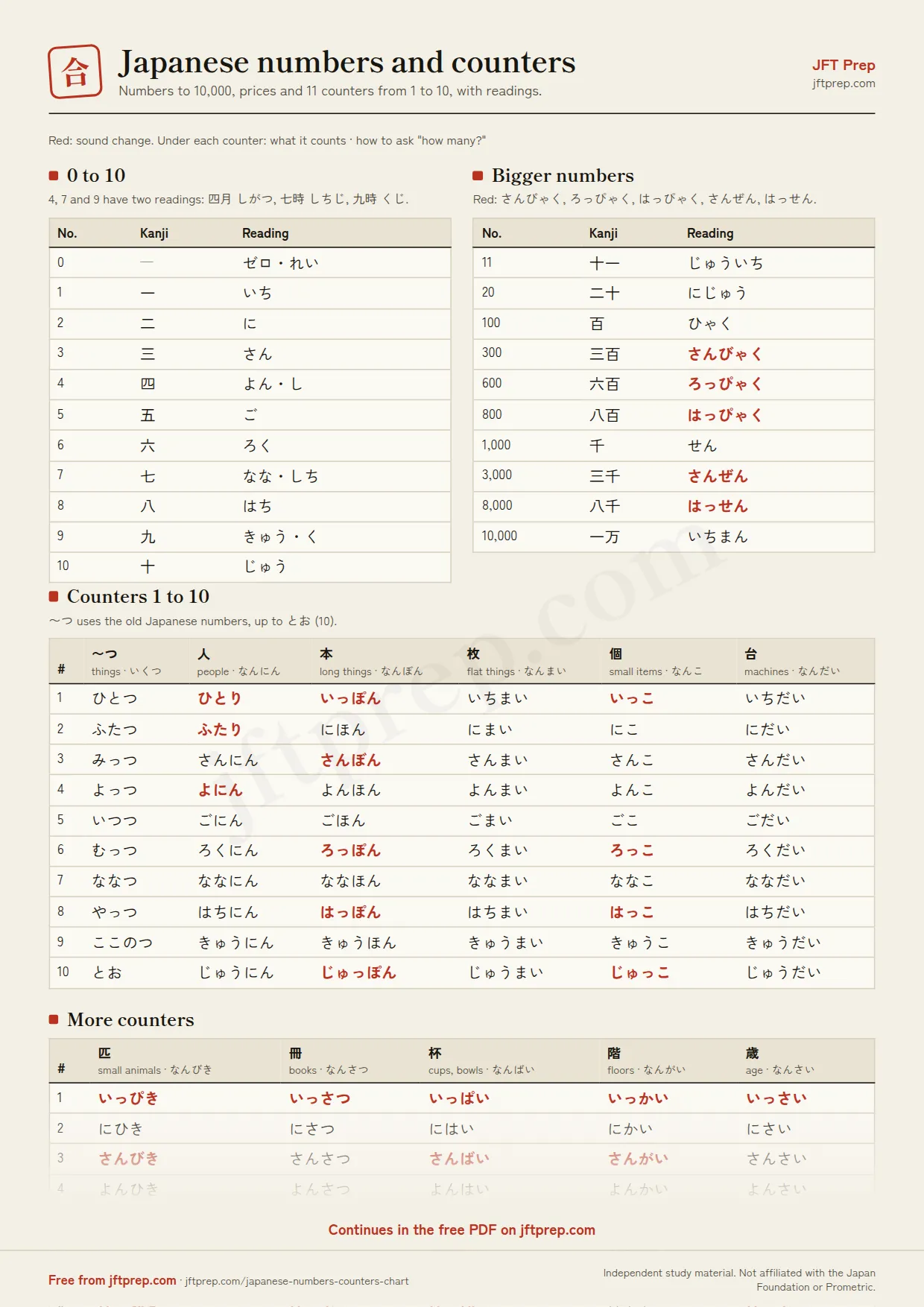
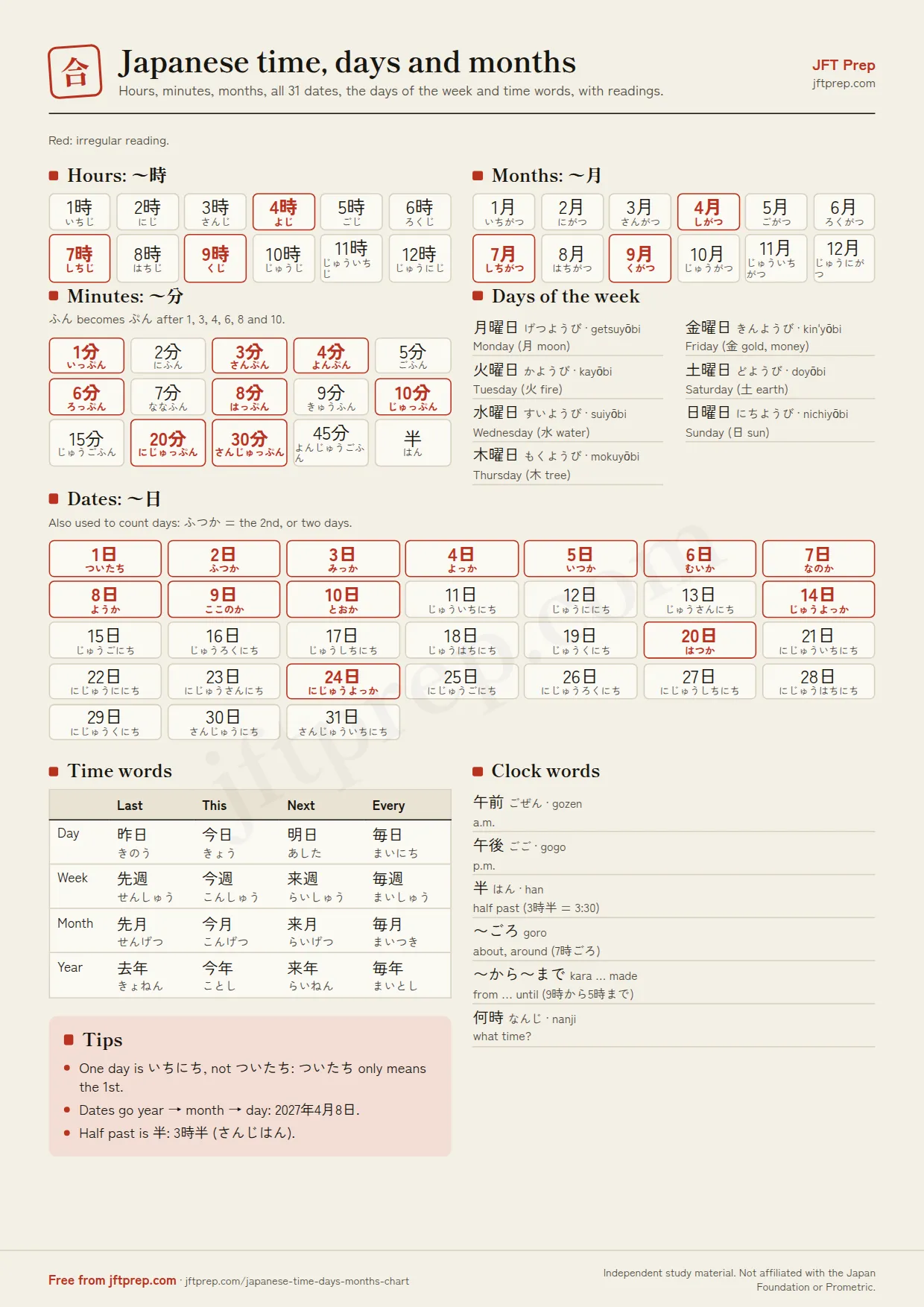
The test format guide shows how the four sections fit on the clock, and the sample questions guide walks through each question type.
The short version
Read the question and name the pictures before you press play. Use play 1 for the overall meaning and pick a working answer. Use play 2 only to settle the one detail you are unsure of, or skip it if you are sure. Read both questions on two-question clips first, and never press Next without an answer: in listening, there is no way back.