From zero, plan on about 350 hours of study to reach a score of 200, the A2 level the SSW visa needs. At 2 hours a day, six days a week, that is about 7 months. At 1 hour a day, it is about 14 months. Fast learners with full-time hours finish sooner; busy workers often take longer.
- zero to 200 (our planning estimate)
- ~350 h
- at 2 hours a day
- ~7 months
- at 1 hour a day
- ~14 months
- the main book, Irodori
- Free
This is the same estimate our home-page timeline uses. It is a rough guide, not a promise. The rest of this post turns those hours into a month-by-month roadmap, with a self-check at each milestone.
Where does "350 hours" come from?
There is no official figure for the JFT-Basic. Around 350 hours is a common guide for beginner Japanese to reach A2 (roughly the JLPT N4 level). The Japan Foundation's own coursebook supports it.
The Irodori FAQ estimates each lesson at about 150–180 minutes of activities, plus 1–2 hours of language practice. That is roughly 4–5 hours per lesson. The three books you need for the SSW level (Starter, Elementary 1 and Elementary 2) have 18 lessons each. Add it up:
| What | Hours (our estimate) |
|---|---|
| Hiragana and katakana | ~50 |
| Irodori Starter (A1) | ~80 |
| Irodori Elementary 1 (A2) | ~80 |
| Irodori Elementary 2 (A2) | ~80 |
| Review, extra listening and mock tests | ~60 |
| Total | ~350 |
Our 3-month plan is the fast route: Starter and Elementary 1 only, about 160 hours of coursebook study, at 12–15 hours a week. It suits full-time learners with a strong start. If you study after a full working day, 350 hours is the safer number.
Your situation
Choose a test date (or tick "I haven't booked yet") to see your plan.
Start with week 1, task 1
Take the free practice testHours and dates are our estimate from common study-time guides, not an official figure. Real progress varies: check it with a timed mock test every few weeks.
Your roadmap: 1 hour a day vs 2 hours a day
Both plans assume six study days a week, about 26 days a month.
| Stage | 1 hour a day | 2 hours a day | Hours done |
|---|---|---|---|
| Kana: read all hiragana and katakana | Months 1–2 | Month 1 | ~50 |
| A1: Irodori Starter | Months 3–6 | Months 2–3 | ~150 |
| Almost A2: Elementary 1 and most of Elementary 2 | Months 7–11 | Months 4–6 | ~270 |
| 200: finish, review, mock tests, book | Months 12–14 | Month 7 | ~350 |
What each stage looks like:
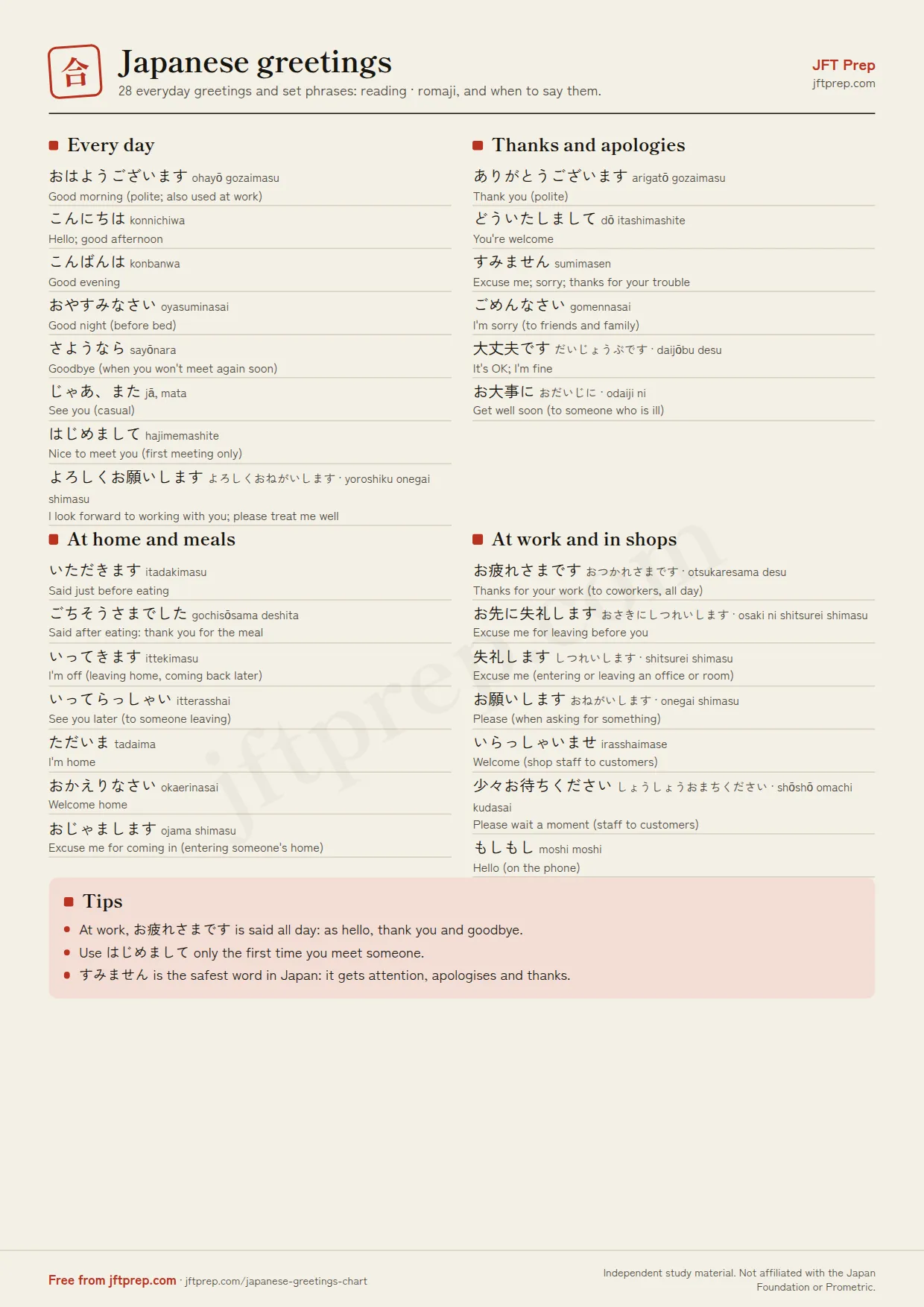
Kana stage. Learn hiragana in the first two weeks, then katakana. Drill with the kana quiz twice a day. Stop using romaji. Learn greetings like おはようございます and すみません as you go.
A1 stage. Work through Irodori Starter: listen first, read second, say it aloud third. Copy each lesson's new kanji once by hand. Learn words by scene: shop, station, clinic, work.
Almost-A2 stage. Elementary 1 and 2 add the grammar the test leans on: 〜てから, 〜ながら, 〜たら, 〜ので, 〜ても. Keep 20–30 minutes a day for listening only.
Final stage. Take full timed mock tests: 60 minutes, one sitting, each clip played at most 2 times. Fix your weakest section. Book when you clear 200 twice in a row.
What one study day looks like
Hours only count if they are the right hours. Here is how to split a day in the A1 and A2 stages.
On 1 hour a day:
- 10 minutes: kana and kanji flashcards.
- 35 minutes: one Irodori activity block.
- 15 minutes: listening only, with no text.
On 2 hours a day:
- 15 minutes: kanji review, then write five words from memory.
- 60 minutes: Irodori, about half a lesson.
- 20 minutes: vocabulary by scene (shop, station, clinic, work).
- 25 minutes: listening only. Write down every number, time and price you hear.
Take one day off each week. Rest helps memory, and the plans above already allow for it.
Milestone 1 self-check: kana
You are ready to move on when you can read every character without stopping. Try these:
Kana check
0 of 4 right
1.How do you read ねこ?
2.How do you read きって?
3.Which is katakana for 'bus'?
4.How do you read しゃしん?
Missed one? Spend another week on the kana quiz. Everything later depends on fast kana.
Milestone 2 self-check: basic kanji
At A1, you should read the kanji you see every day: on signs, timetables and shop doors.
Basic kanji check
0 of 4 right
1.出口
2.午後
3.休み
4.電車
If this felt hard, use the kanji list by topic. Learn the reading and a real place you would see it.
Milestone 3 self-check: grammar
This is the "almost A2" stage. On the test, grammar choices are often one verb in four forms. Only one fits the words after the gap.
Grammar check
0 of 4 right
1.まいあさ ごはんを( )、はを みがきます。
2.あぶないですから、( )スマホを 見ないで ください。
3.あめが( )、しあいは ありません。
4.ねつが( )、きょうは やすみます。
Three or four right? Start full mock tests. Fewer? Go back to the grammar notes in Irodori Elementary 1 and try the grammar quiz.
The free resources that are enough
You don't need to buy a "JFT-Basic book". These come from the Japan Foundation and are free:
- Irodori: Japanese for Life in Japan. The main book. PDFs with MP3 audio, built on the same Can-do goals as the test. Read our Irodori study guide to use it well.
- The IRODORI Japanese Online Course. Video lessons plus kanji and grammar practice at A1–A2. Good if you learn better from a screen.
- The official sample questions on the Japan Foundation's JFT-Basic site, with audio. Do them once you finish Starter.
Then add practice in the real format: our free practice test to start, and full mock tests at the end.
Common mistakes when starting from zero
Collecting resources instead of using one. Three apps, two YouTube channels and a textbook feel productive. Finishing one book is what moves your score. Pick Irodori and finish it.
Staying on romaji. It feels faster in week one and slows you down for months. The test has no romaji and no furigana.
Studying words without scenes. The test asks what you would understand at a station, a clinic or a workplace. Learn 受付 together with "the desk where you check in at a clinic", not as a lone word.
Skipping listening. Your ear grows slowly. Twenty minutes a day from the first month beats three hours a week before the test.
Booking on a deadline instead of a score. An agent's date is not a plan. If you score under 200, you wait 45 days and pay again. Book when your mocks say yes.
Start with your real level
The 350-hour figure is for someone at true zero. If you already read kana or know some basic Japanese, you may need far less. The quickest way to find out is to take the free practice test. It shows your estimated band in about 15 minutes.
Free toolFind out how far you are from 20012 original questions, all four sections, a free band estimate. No sign-up.